









I. Increased rate and intensity of heartbeat
Select the correct answer:
1. Reaction to any stimulus is called:
A) receptor
B) impulse
C) responses
D) effector
Answer: C) responses
Explanation: A response is the reaction of an organism to a stimulus. The sequence is: Stimulus [source symbol unavailable] Receptor [source symbol unavailable] Coordinator (CNS) [source symbol unavailable] Effector [source symbol unavailable] Response. An impulse is the electrical signal traveling along a neuron. An effector is the muscle or gland that carries out the response.
2. The unit of structure and function in the nervous system is:
A) neuron
B) muscle cell
C) nephron
D) cardiac cell
Answer: A) neuron
Explanation: The neuron (nerve cell) is the structural and functional unit of the nervous system. It is specialized for transmitting electrical impulses. A nephron is the functional unit of the kidney, and muscle cells are part of the muscular system.
3. Thyroid gland has the ability to store:
A) Iodine
B) chlorine
C) fluorine
D) zinc
Answer: A) Iodine
Explanation: The thyroid gland actively absorbs and stores iodine from the blood. Iodine is essential for the synthesis of thyroid hormones, thyroxine (T4) and triiodothyronine (T3), which regulate metabolism.
4. Endocrine glands pour their secretion directly into:
A) lymph
B) blood
C) organs
D) muscles
Answer: B) blood
Explanation: Endocrine glands are ductless glands that secrete hormones directly into the bloodstream. The blood then transports these hormones to target cells and organs throughout the body. Exocrine glands secrete through ducts to the surface or into cavities.
5. Islet of Langerhans are parts of the:
A) thyroid gland
B) adrenal gland
C) pancreas
D) gonads
Answer: C) pancreas
Explanation: The Islets of Langerhans are clusters of cells within the pancreas that function as an endocrine gland. They contain alpha cells (secrete glucagon), beta cells (secrete insulin), and delta cells (secrete somatostatin).
6. Nerve impulse is best described as:
A) chemical
B) electrical
C) osmotic
D) electrochemical
Answer: D) electrochemical
Explanation: A nerve impulse is best described as an electrochemical signal. It involves the movement of ions (electrical) across the neuron membrane and the release of neurotransmitters (chemical) at synapses to transmit the signal to the next neuron.
7. When a person is frightened, which substance increases the blood sugar level?
A) adrenaline
B) amylase
C) glycogen
D) insulin
Answer: A) adrenaline
Explanation: Adrenaline (epinephrine) is the "fight or flight" hormone released by the adrenal medulla during stress or fear. It stimulates the breakdown of glycogen into glucose in the liver, increasing blood sugar levels to provide quick energy.
8. Which part of the brain detects temperature changes in the blood?
A) cerebellum
B) cerebral hemispheres
C) hypothalamus
D) medulla
Answer: C) hypothalamus
Explanation: The hypothalamus contains thermoreceptors that monitor the temperature of the blood. It acts as the body's thermostat, initiating responses like sweating or shivering to maintain a stable core temperature.
10. In contrast to nerve, the response produced by hormones takes longer because:
A) hormones are specific in their action.
B) hormones are transported through blood.
C) hormones are produced in small amounts.
D) the molecules of hormones are small in size.
Answer: B) hormones are transported through blood.
Explanation: Hormones are secreted into the bloodstream and must travel to target cells, which takes time. In contrast, nerve impulses travel rapidly along dedicated neurons, allowing for immediate responses.
11. Once released, neurotransmitter molecules typically produce signals in postsynaptic neurons by:
A) entering the postsynaptic neuron
B) attaching to vesicles
C) binding to presynaptic receptors
D) binding to postsynaptic receptors
Answer: D) binding to postsynaptic receptors
Explanation: Neurotransmitters diffuse across the synaptic cleft and bind to specific receptor proteins on the postsynaptic membrane. This binding triggers an electrical change in the postsynaptic neuron, propagating the signal.
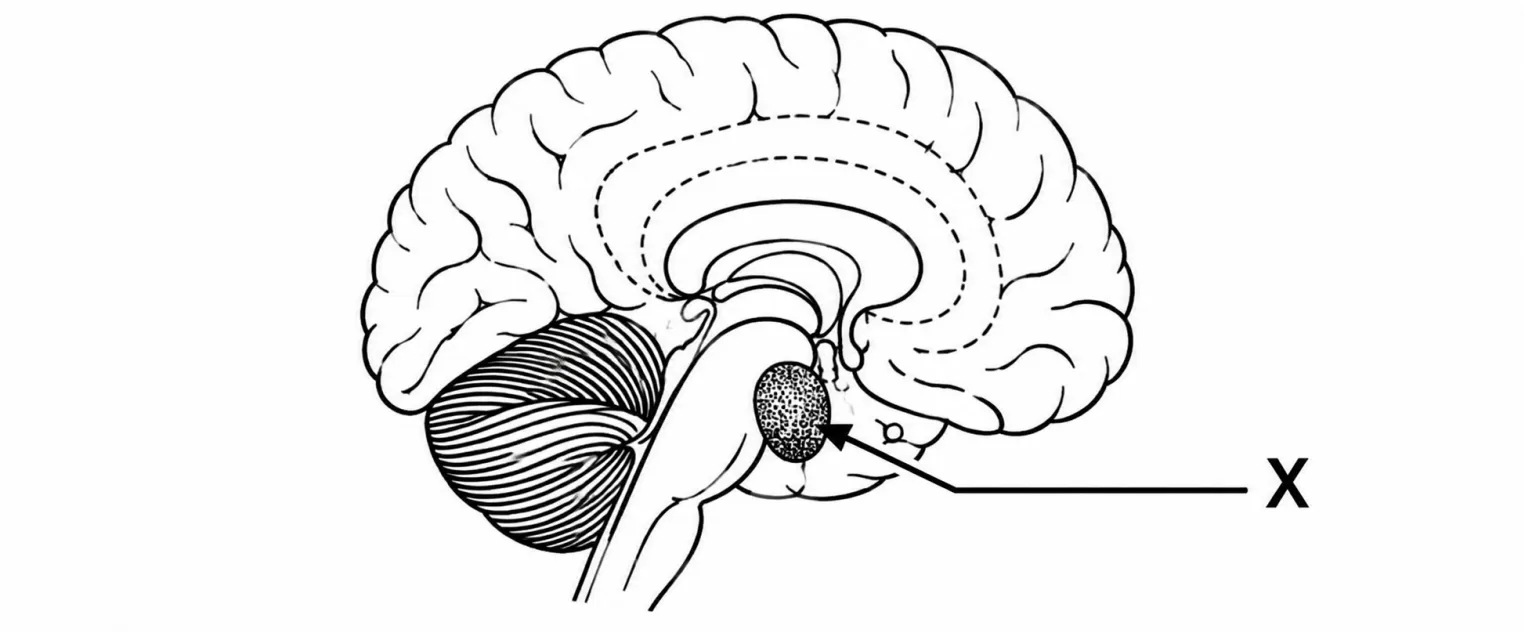
12. The parts of brain represented by I and II are: (Diagram of brain with labels I and II)
| I | II | |
| A) | cerebellum | pons |
| B) | cerebrum | pons |
| C) | cerebellum | medulla oblongata |
| D) | cerebrum | medulla oblongata |
Answer: A) cerebellum, pons (Note: Based on the diagram, I points to the cerebellum, and II points to the pons.)
13. The diagram shows Reflex arc. The components of this reflex arc are:
| 1 | 2 | 3 | 4 | 5 | |
| A) | Receptor | Sensory neuron | Motor neuron | Interneuron | Effector |
| B) | Sensory neuron | Motor neuron | Interneuron | Receptor | Effector |
| C) | Receptor | Effector | Sensory neuron | Interneuron | Motor neuron |
| D) | Receptor | Sensory neuron | Interneuron | Motor neuron | Effector |
Answer: D) Receptor, Sensory neuron, Interneuron, Motor neuron, Effector
Explanation: The correct sequence of a reflex arc is: Receptor [source symbol unavailable] Sensory (Afferent) Neuron [source symbol unavailable] Interneuron (in CNS) [source symbol unavailable] Motor (Efferent) Neuron [source symbol unavailable] Effector.
14. Four characters of a specific hormone are listed below:
II. Increased blood pressure
III. Decreased blood flow to skin & alimentary canal
IV. Increased blood flow to limb Which is this hormone?
Answer: A) adrenaline
Explanation: Adrenaline is the "fight or flight" hormone. It increases heart rate, blood pressure, and blood flow to skeletal muscles (limbs), while reducing blood flow to non-essential organs like the skin and digestive system.