









PhysicsChapter 2: Vectors
Vector Product or Cross Product
Subtopic 2 — Vector Product or Cross Product
Vector Product (Cross Product)
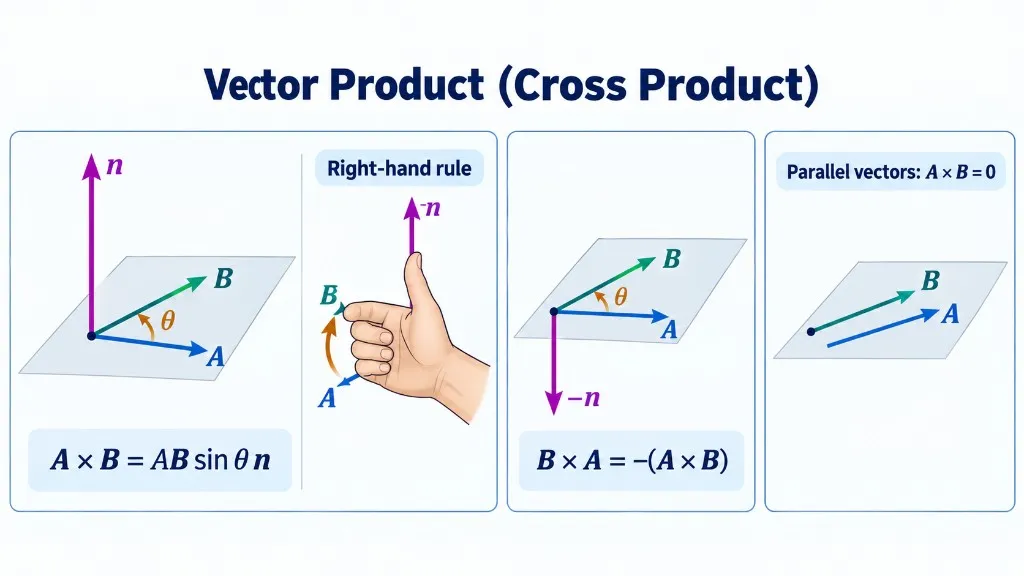
Physical Meaning of Cross Product
The cross product measures the perpendicular interaction between two vectors. Its result contains: A magnitude A direction The magnitude is: |A⃗ × B⃗| = AB sin θ The direction is determined using the right-hand rule.
Direction of Cross Product
The direction of A⃗ × B⃗ is perpendicular to both A⃗ and B⃗. Right-Hand Rule 1. Point the fingers of your right hand along A⃗. 2. Curl them toward B⃗ through the smaller angle. 3. Your thumb indicates the direction of A⃗ × B⃗. Changing the order reverses the direction: B⃗ × A⃗ = −(A⃗ × B⃗)
Cross Product at Special Angles
Parallel Vectors When θ = 0°: |A⃗ × B⃗| = AB sin 0° = 0 Perpendicular Vectors When θ = 90°: |A⃗ × B⃗| = AB sin 90° = AB The cross product has its maximum magnitude. Opposite Vectors When θ = 180°: |A⃗ × B⃗| = AB sin 180° = 0
Cross Products of Unit Vectors
The basic cyclic order is: î → ĵ → k̂ → î Following this order gives a positive result: î × ĵ = k̂ ĵ × k̂ = î k̂ × î = ĵ Reversing the order gives a negative result: ĵ × î = −k̂ k̂ × ĵ = −î î × k̂ = −ĵ The cross product of a unit vector with itself is zero: î × î = 0 ĵ × ĵ = 0 k̂ × k̂ = 0
Cross Product Using Components
Consider: A⃗ = Aₓ î + Aᵧ ĵ + Az k̂ B⃗ = Bₓ î + Bᵧ ĵ + Bz k̂ Then: A⃗ × B⃗ = (AᵧBz − AzBᵧ) î + (AzBₓ − AₓBz) ĵ + (AₓBᵧ − AᵧBₓ) k̂ It may also be written as the determinant with rows (î ĵ k̂), (Aₓ Aᵧ Az), (Bₓ Bᵧ Bz).
Properties of Cross Product
Anti-Commutative Property A⃗ × B⃗ = −(B⃗ × A⃗) Distributive Property A⃗ × (B⃗ + C⃗) = A⃗ × B⃗ + A⃗ × C⃗ Cross Product of a Vector With Itself A⃗ × A⃗ = 0 Scalar Multiplication (mA⃗) × (nB⃗) = mn(A⃗ × B⃗) Not Generally Associative Usually: A⃗ × (B⃗ × C⃗) ≠ (A⃗ × B⃗) × C⃗
Area Represented by Cross Product
The magnitude of a cross product gives the area of a parallelogram formed by two vectors: Area of parallelogram = |A⃗ × B⃗| The area of a triangle formed by the same vectors is: Area of triangle = (12)|A⃗ × B⃗|
Applications of Cross Product
Applications
- Torque: τ⃗ = r⃗ × F⃗ ; τ = rF sin θ
- Angular Momentum: L⃗ = r⃗ × p⃗
- Magnetic Force on a Charge: F⃗ = q(v⃗ × B⃗)
- Magnetic Force on a Wire: F⃗ = I(L⃗ × B⃗)
- Area of a Parallelogram: A = |a⃗ × b⃗|
Solved Examples — Cross Product
Solved Example 4: Magnitude of Cross Product
Two vectors have magnitudes 5 and 7. The angle between them is 30°. Find the magnitude of their cross product.
- A = 5
- B = 7
- θ = 30°
|A⃗ × B⃗| = AB sin θ
|A⃗ × B⃗| = (5)(7) sin 30°
|A⃗ × B⃗| = 35(0.5)
|A⃗ × B⃗| = 17.5
The direction is perpendicular to both vectors and is determined using the right-hand rule.
Final answer: |A⃗ × B⃗| = 17.5
Solved Example 5: Cross Product of Two-Dimensional Vectors
Find the cross product of A⃗ = 2î + 3ĵ and B⃗ = î − 4ĵ.
- Aₓ = 2
- Aᵧ = 3
- Bₓ = 1
- Bᵧ = −4
A⃗ × B⃗ = (AₓBᵧ − AᵧBₓ) k̂
A⃗ × B⃗ = [(2)(−4) − (3)(1)] k̂
A⃗ × B⃗ = [−8 − 3] k̂
A⃗ × B⃗ = −11 k̂
The negative sign shows that the direction is along the negative z-axis.
Final answer: A⃗ × B⃗ = −11 k̂
Solved Example 6: Three-Dimensional Cross Product
Calculate A⃗ = î + 2ĵ + 3k̂ and B⃗ = 4î + 5ĵ + 6k̂ cross product.
x-component: AᵧBz − AzBᵧ = (2)(6) − (3)(5) = 12 − 15 = −3
y-component: AzBₓ − AₓBz = (3)(4) − (1)(6) = 12 − 6 = 6
z-component: AₓBᵧ − AᵧBₓ = (1)(5) − (2)(4) = 5 − 8 = −3
Final answer: A⃗ × B⃗ = −3î + 6ĵ − 3k̂
Solved Example 7: Torque
A force of 50 N is applied perpendicular to a lever arm of length 0.40 m. Calculate the torque.
- r = 0.40 m
- F = 50 N
- θ = 90°
τ = rF sin θ
τ = (0.40)(50) sin 90°
τ = (0.40)(50)(1)
τ = 20 N m
Final answer: τ = 20 N m
Did you understand this topic?
Your answer is saved with your learning record. It does not mark the topic as mastered.
Quick revision
Revision Zone
Review the key facts, formulas and checks before you move on.Vector Product or Cross Product
Sticky Notes · Quick Revision
Sticky Note
- I → +,+
- II → −,+
- III → −,−
- IV → +,−
Same supplied content as this Notes page (shared canonical source).