









Law of Conservation of Momentum
Book Subtopic
- 3.3.1 Applications of Conservation of Momentum
1. Learning Outcomes
After studying this topic, students should be able to:
- Define linear momentum.
- Explain the meaning of a system and an isolated system.
- State the law of conservation of momentum.
- Explain the role of internal and external forces.
- Derive the conservation law using Newton’s laws.
- Apply momentum conservation to one-dimensional interactions.
- Use correct positive and negative velocity signs.
- Explain recoil and propulsion qualitatively.
- Solve momentum-conservation numerical problems.
- Distinguish momentum conservation from kinetic-energy conservation.
2. Definition of Momentum
3. Momentum Is a Vector
Momentum is a vector quantity because velocity is a vector. Its direction is the same as the direction of velocity. If rightward motion is selected as positive: v > 0 for rightward motion, and: v < 0 for leftward motion. Therefore, momentum can also have a positive or negative sign.
4. Symbols and Units
Symbols and Units
| Quantity | Symbol | SI unit |
|---|---|---|
| Momentum | p⃗ | kg m s⁻¹ |
| Mass | m | kg |
| Velocity | v⃗ | m s⁻¹ |
| Force | F⃗ | N |
| Time interval | Δt | s |
| Impulse | J⃗ | N s |
Momentum may also be expressed as: N s because: 1 N s = 1 kg m s⁻¹
5. Definition of a System
A system is a selected object or collection of objects that is being studied. Everything outside the selected system is called its surroundings or environment. For example, two interacting laboratory carts may be treated as one system.
6. Isolated System
7. Internal and External Forces
Internal Forces
Internal forces act between objects that belong to the same system. Examples include the forces exerted by two colliding carts on each other. According to Newton’s third law, internal forces occur in equal and opposite pairs.
External Forces
External forces are exerted by objects outside the selected system. Examples include:
- Friction from the ground
- Air resistance
- An external applied force
- A force from an object outside the system
Internal forces can change the momenta of individual objects but cannot change the total momentum of an isolated system.
8. Law of Conservation of Momentum
Statement
The total momentum of an isolated system of interacting particles remains constant. Therefore: p⃗i = p⃗f Here: p⃗i is the total initial momentum. p⃗f is the total final momentum. The change in total momentum is: Δ p⃗_system = 0
9. Two-Object Conservation Equation
For two objects before and after an interaction: Initial momentum = Final momentum Therefore: m₁ u⃗₁ + m₂ u⃗₂ = m₁ v⃗₁ + m₂ v⃗₂ Where: m₁, m₂ are the masses. u⃗₁, u⃗₂ are the initial velocities. v⃗₁, v⃗₂ are the final velocities.
10. Diagram Placement
Conservation of Momentum
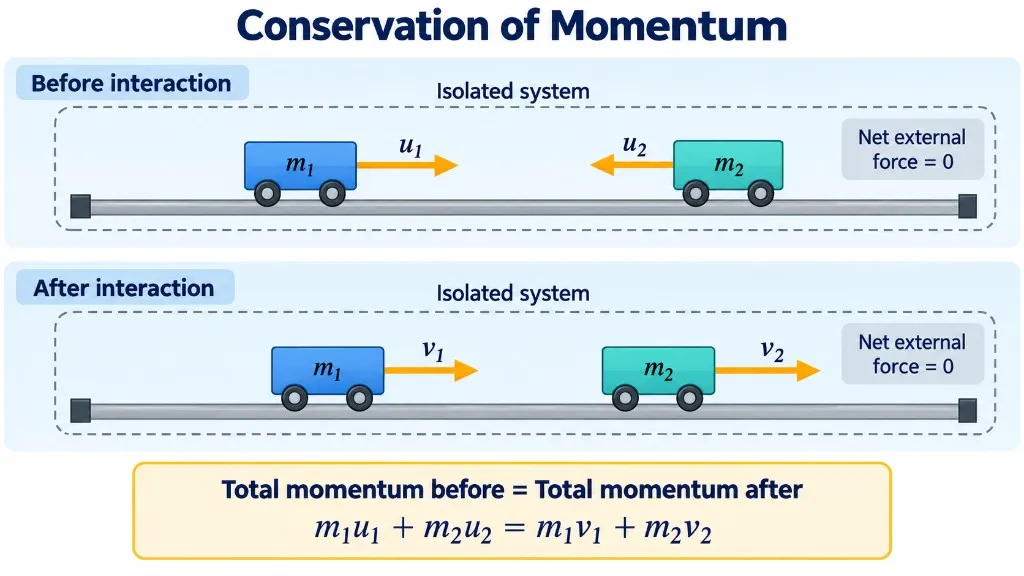
The equation should also remain available as searchable HTML text: m₁u₁ + m₂u₂ = m₁v₁ + m₂v₂
11. Concept in Easy Words
During an interaction, momentum may transfer from one object to another. One object may lose momentum while another gains momentum. However, if no resultant external force acts: Total momentum before = Total momentum after Individual momenta can change, but their vector sum remains constant.
12. Derivation From Newton’s Laws
Consider two objects interacting in an isolated system. The force exerted by object 1 on object 2 is: F⃗₁₂ The force exerted by object 2 on object 1 is: F⃗₂₁ According to Newton’s third law: F⃗₁₂ = −F⃗₂₁ Using Newton’s second law in momentum form: F⃗ = Δp⃗ / Δt Therefore: Δp⃗₂ / Δt = −Δp⃗₁ / Δt Multiplying by Δt: Δp⃗₂ = −Δp⃗₁ Therefore: Δp⃗₁ + Δp⃗₂ = 0 So: Δ(p⃗₁ + p⃗₂) = 0 Hence: p⃗₁ᵢ + p⃗₂ᵢ = p⃗₁f + p⃗₂f The total momentum remains constant.
13. Connection Between Force and Momentum
Newton’s second law can be written as: F⃗ = Δp⃗ / Δt Therefore: Δp⃗ = F⃗ Δt The quantity F⃗ Δt is impulse. J⃗ = Δp⃗ For the same momentum change: A shorter interaction time produces a larger average force. A longer interaction time produces a smaller average force. This principle explains why safety padding and vehicle crumple zones reduce impact force by increasing interaction time.
14. Momentum Conservation in One Dimension
For one-dimensional motion, select one direction as positive. For example: Rightward velocity: positive Leftward velocity: negative Then use: m₁u₁ + m₂u₂ = m₁v₁ + m₂v₂ The signs automatically represent the directions. A negative calculated velocity means the object moves opposite to the selected positive direction.
15. Momentum Conservation in Two Dimensions
Momentum must be conserved separately along perpendicular directions.
Along the x-axis
Σ pix = Σ pfx
Along the y-axis
Σ piy = Σ pfy
All momentum vectors must first be resolved into components.
27. Momentum and Kinetic Energy Comparison
Momentum and Kinetic Energy Comparison
| Feature | Momentum | Kinetic energy |
|---|---|---|
| Formula | p⃗ = m v⃗ | K = ½mv² |
| Nature | Vector | Scalar |
| Conserved in isolated collisions | Yes | Only in elastic collisions |
| Direction required | Yes | No |
| SI unit | kg m s⁻¹ | J |
A system can conserve momentum even when some kinetic energy changes into sound, thermal energy or deformation.
28. Key Logic
Momentum conservation depends on the total external force, not on whether individual objects experience forces. Individual objects may experience large internal forces. However, these internal forces occur in equal and opposite pairs. Therefore: Δp⃗₁ = −Δp⃗₂ and: Δp⃗_total = 0
29. Tips and Tricks
- Convert all masses into kilograms.
- Select a positive direction before substitution.
- Give opposite directions opposite signs.
- Include all objects belonging to the system.
- Add momenta algebraically, not just their magnitudes.
- Do not assume the total initial momentum is zero unless the complete system starts at rest.
- Keep unrounded values until the final step.
- Add the direction to the final velocity.
- Check whether the system can reasonably be treated as isolated.
30. Common Mistakes
- Ignoring the vector nature of momentum.
- Treating every speed as positive.
- Forgetting to convert grams into kilograms.
- Conserving the momentum of only one object.
- Assuming each object’s momentum remains constant.
- Assuming kinetic energy is always conserved.
- Using external forces as internal forces.
- Rounding values too early.
- Omitting stationary objects from the momentum equation.
- Confusing force with momentum.
31. Remember Box
32. Exam Facts
- Momentum is a vector.
- Its SI unit is kg m s⁻¹.
- An isolated system has zero resultant external force.
- Internal forces cannot change total system momentum.
- Momentum is conserved in all isolated collisions.
- Kinetic energy is conserved only in elastic collisions.
- Recoil direction is opposite to the launched object’s direction.
- Propulsion is based on equal and opposite momentum changes.
- The negative sign in an answer normally indicates direction.
- Momentum must be conserved separately along x and y in two dimensions.
33. Short-Question Preparation
Short-Question Preparation
Q. What is an isolated system?
A. An isolated system is one on which the resultant external force is zero. Objects inside it may exert internal forces on one another. These forces can change individual momenta but cannot change the total momentum. Ideal isolation is difficult to achieve, so external forces are often treated as negligible during a short interaction.
Q. State the law of conservation of momentum.
A. The law states that the total momentum of an isolated system remains constant. Therefore, total initial momentum equals total final momentum. Individual objects may gain or lose momentum. However, the vector sum of their momenta does not change when the resultant external force is zero.
Q. Why does a heavier launcher recoil more slowly?
A. The launcher and projected object gain equal and opposite momenta. Momentum is mass multiplied by velocity. Because the launcher has much greater mass, it requires a smaller velocity to have momentum equal in magnitude to that of the lighter object.
Q. Is kinetic energy always conserved with momentum?
A. No. Momentum is conserved in every isolated collision. Kinetic energy is conserved only in an elastic collision. During an inelastic collision, some kinetic energy changes into other forms. Therefore, momentum conservation does not automatically imply kinetic-energy conservation.
34. Long-Question Preparation
State and derive the law of conservation of momentum.
Consider two objects interacting in an isolated system. The resultant external force on the system is zero. Object 1 exerts force F⃗₁₂ on object 2. Object 2 exerts force F⃗₂₁ on object 1. Newton’s third law gives: F⃗₁₂ = −F⃗₂₁ Force is equal to the rate of change of momentum. Therefore: Δp⃗₂ / Δt = −Δp⃗₁ / Δt Multiplying by the interaction time gives: Δp⃗₂ = −Δp⃗₁ Therefore: Δp⃗₁ + Δp⃗₂ = 0 The total momentum does not change. Hence: p⃗i = p⃗f For two objects: m₁ u⃗₁ + m₂ u⃗₂ = m₁ v⃗₁ + m₂ v⃗₂ The law applies to isolated collisions and separation events. It also explains recoil and propulsion. The conservation equation must include directions. Therefore, momenta should be treated as vectors.
38. Sticky Notes
Sticky Notes
- Momentum: p⃗ = m v⃗
- Momentum is a vector.
- Isolated system: Σ F⃗_external = 0
- Total initial momentum equals total final momentum.
- Directions require positive and negative signs.
- Internal forces change individual momenta.
- Internal forces do not change total momentum.
- Momentum is conserved in both elastic and inelastic collisions.
- Kinetic energy is not always conserved.
39. 60-Second Revision
p⃗ = m v⃗ Σ p⃗i = Σ p⃗f For two objects: m₁ u⃗₁ + m₂ u⃗₂ = m₁ v⃗₁ + m₂ v⃗₂ For a system initially at rest: m₁ v⃗₁ + m₂ v⃗₂ = 0 Impulse: J⃗ = Δp⃗
40. Topic Summary
The total momentum of an isolated system remains constant because internal forces occur in equal and opposite pairs. Momentum may transfer between interacting objects, but its total vector value does not change. This principle explains collisions, recoil, separation events and propulsion.
Did you understand this topic?
Your answer is saved with your learning record. It does not mark the topic as mastered.
Exam preparation
Exam Focus
Quick revision
Revision Zone
Law of Conservation of Momentum
Sticky Notes · Quick Revision
Momentum
- Momentum: p⃗ = m v⃗
- Momentum is a vector.
- Isolated system: Σ F⃗_external = 0
- Total initial momentum equals total final momentum.
- Directions require positive and negative signs.
Internal forces
- Internal forces change individual momenta.
- Internal forces do not change total momentum.
- Momentum is conserved in both elastic and inelastic collisions.
- Kinetic energy is not always conserved.
Same supplied content as this Notes page (shared canonical source).