









PhysicsChapter 5: Work and Kinetic Energy
Work Done by a Constant Force
Overview
In physics, work is done when a force causes an object to move through a displacement.
Work depends on:
- Magnitude of the force
- Magnitude of displacement
- Angle between force and displacement
For a constant force:
W = F⃗ · d⃗
or:
W = Fd cos θ
Learning Outcomes
Students should be able to:
- Define work scientifically.
- Explain why work is a scalar quantity.
- Calculate work done by a constant force.
- Resolve force into parallel and perpendicular components.
- Differentiate between positive, negative and zero work.
- Calculate work done by several forces.
- State the SI unit and dimensions of work.
1. Definition of Work
Work done on an object is the scalar or dot product of force and displacement:
W = F⃗ · d⃗
Its magnitude is:
W = Fd cos θ
Where:
- W = work done
- F = magnitude of constant force
- d = magnitude of displacement
- θ = angle between force and displacement
Work is a scalar quantity because a dot product produces a scalar.
2. Conditions Necessary for Work
For mechanical work to be done:
- A force must act on the object.
- The object must undergo displacement.
- The force must have a component along the displacement.
If any of these conditions is missing, the work done is zero.
3. Effective Component of Force
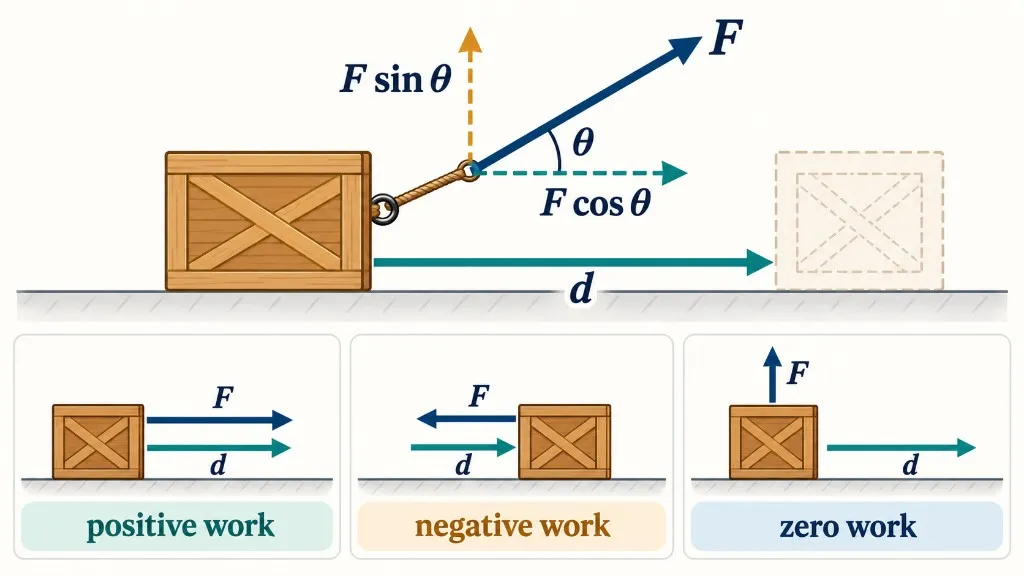
Suppose a force F acts at angle θ to horizontal displacement d.
The force has two components:
Parallel component
F∥ = F cos θ
This component acts along the displacement and performs work.
Perpendicular component
F⊥ = F sin θ
This component is perpendicular to the displacement and performs no work.
Therefore:
W = F∥ d W = (F cos θ) d
Work Done by a Constant Force
Intermediate Level
4. Positive Work
Work is positive when force has a component in the direction of displacement.
The angle lies in the range:
0° ≤ θ < 90°
In this range:
cos θ > 0
Therefore:
W > 0
Maximum positive work
When force and displacement act in the same direction:
θ = 0° W = Fd cos 0° W = Fd
Examples include:
- Pulling a box forward
- Gravity acting on a falling object
- An engine moving a vehicle forward
5. Negative Work
Work is negative when force has a component opposite to displacement.
The angle lies in the range:
90° < θ ≤ 180°
In this range:
cos θ < 0
Therefore:
W < 0
When force acts directly opposite to displacement:
θ = 180° W = Fd cos 180° W = −Fd
Examples include:
- Friction acting on a sliding object
- Braking force acting on a moving vehicle
- Air resistance opposing motion
Negative work generally removes mechanical energy from an object.
6. Zero Work
Work is zero when force is perpendicular to displacement:
θ = 90°
Therefore:
W = Fd cos 90° W = 0
Work is also zero when:
F = 0
or:
d = 0
Examples include:
- Normal reaction on an object moving horizontally
- Gravitational force on an object moving horizontally
- Holding a stationary object
- Centripetal force in uniform circular motion
7. Work and Angle
Work and Angle
| Angle θ | Value of cos θ | Type of work |
|---|---|---|
| 0° | 1 | Maximum positive |
| Between 0° and 90° | Positive | Positive |
| 90° | 0 | Zero |
| Between 90° and 180° | Negative | Negative |
| 180° | −1 | Maximum negative |
8. Net Work Done by Several Forces
If several constant forces act on an object, calculate the work performed by each force separately.
W₁ = F₁ d cos θ₁ W₂ = F₂ d cos θ₂ W₃ = F₃ d cos θ₃
The net work is:
Wnet = W₁ + W₂ + W₃ + ⋯
or:
Wnet = Σᵢ Fᵢ d cos θᵢ
For horizontal displacement:
- Horizontal forces may perform positive or negative work.
- Weight performs zero work.
- Normal reaction performs zero work.
9. SI Unit of Work
From:
W = Fd
The unit of force is newton and the unit of displacement is metre.
Therefore:
[W] = N m
The SI unit of work is the joule:
1 J = 1 N m
Using:
1 N = 1 kg m s⁻²
Therefore:
1 J = 1 kg m s⁻² × 1 m 1 J = 1 kg m² s⁻²
10. Dimensions of Work
W = Fd
Dimensions of force are:
[F] = [MLT⁻²]
Therefore:
[W] = [MLT⁻²][L] [W] = [ML²T⁻²]
Work and energy have the same unit and dimensions because work represents energy transferred by a force.
11. Work Is Not the Same as Effort
In everyday language, holding a heavy object may feel like hard work. However, if the object does not move:
d = 0
Therefore:
W = F(0) cos θ W = 0
Mechanical work may be zero even though the person uses biological energy.
Formula Summary
Formula Summary
| Situation | Formula |
|---|---|
| General constant force | W = Fd cos θ |
| Force parallel to displacement | W = Fd |
| Force opposite to displacement | W = −Fd |
| Force perpendicular to displacement | W = 0 |
| Several forces | Wnet = Σ Wᵢ |
| Parallel force component | F∥ = F cos θ |
| Perpendicular component | F⊥ = F sin θ |
Solved Examples
Example 1: Force Along Displacement
A constant force of 20 N moves a box through 5 m in the same direction. Calculate the work done.
Given:
F = 20 N d = 5 m θ = 0°
Formula:
W = Fd cos θ
Solution:
W = (20)(5) cos 0° W = (20)(5)(1) W = 100 J
Final answer:
W = 100 J
Example 2: Force Acting at an Angle
A 50 N force moves an object through 3 m. The force makes an angle of 60° with the displacement.
Formula:
W = Fd cos θ
Solution:
W = (50)(3) cos 60° W = (50)(3)(0.5) W = 75 J
Final answer:
W = 75 J
Example 3: Negative Work by Friction
A frictional force of 8 N opposes an object moving through 6 m.
Given:
F = 8 N d = 6 m θ = 180°
Formula:
W = Fd cos θ
Solution:
W = (8)(6) cos 180° W = (8)(6)(−1) W = −48 J
Final answer:
W = −48 J
Example 4: Textbook Suitcase Example
A suitcase is pulled through 4.90 m by a constant force of 16.8 N acting at 30° above the horizontal. A frictional force of 0.170 N opposes its motion.
Part A: Work done by applied force
WM = FM d cos θM WM = (16.8)(4.90) cos 30° WM = (16.8)(4.90)(0.866) WM = 71.3 J WM = 71.3 J
Part B: Work done by friction
Wf = Ff d cos θf Wf = (0.170)(4.90) cos 180° Wf = (0.170)(4.90)(−1) Wf = −0.833 J Wf = −0.833 J
Part C: Work by weight and normal reaction
Both forces are perpendicular to horizontal displacement:
θ = 90°
Therefore:
Wg = 0 WN = 0
Part D: Net work
Wnet = WM + Wf + Wg + WN Wnet = 71.3 − 0.833 + 0 + 0 Wnet = 70.467 J Wnet ≈ 70.5 J
Scientist Connection
The SI unit of work is named after James Prescott Joule, whose experiments helped establish that heat is a form of energy transfer.
1 joule = 1 newton-metre
Important Exam Facts
- Work is the dot product of force and displacement.
- Work is a scalar quantity.
- Only F cos θ performs work along displacement.
- Work is positive when force supports motion.
- Work is negative when force opposes motion.
- Work is zero when force and displacement are perpendicular.
- No displacement means no mechanical work.
- Net work is the sum of work done by all forces.
- The SI unit is joule.
- The dimensions are [ML²T⁻²].
Common Mistakes
- Using W = Fd when the force acts at an angle.
- Using F sin θ instead of F cos θ.
- Measuring θ from the wrong direction.
- Ignoring the negative sign of frictional work.
- Thinking every acting force performs work.
- Including weight in horizontal motion without checking the angle.
- Confusing work with force or power.
- Writing joule per second as the unit of work.
- Forgetting that work is a scalar.
MCQs with Answers
1. Work done by a constant force is: A. Fd sin θ B. Fd cos θ C. Fd D. Fd² Answer: B — W = Fd cos θ.
2. Work is a: A. Vector quantity B. Scalar quantity C. Base quantity D. Dimensionless quantity Answer: B — Work is obtained from a dot product.
3. Work is zero when force and displacement are: A. Parallel B. Opposite C. Perpendicular D. Equal Answer: C — cos 90° = 0.
4. Friction usually performs: A. Positive work B. Negative work C. Zero work in every case D. Infinite work Answer: B — Friction generally acts opposite to displacement.
5. The SI unit of work is: A. Watt B. Newton C. Joule D. Pascal Answer: C — Joule.
Short-Question Preparation
Short-Question Preparation
Q. Define work and state its formula.
A. Work is the scalar product of force and displacement. For a constant force: W = F⃗ · d⃗ = Fd cos θ. Only the component of force parallel to displacement performs work.
Q. Why does a perpendicular force perform zero work?
A. When force is perpendicular to displacement, the angle is 90°. Since cos 90° = 0, the force has no component along the displacement and performs zero work.
Q. Differentiate between positive and negative work.
A. Positive work occurs when force has a component in the direction of displacement. Negative work occurs when force has a component opposite to displacement. Positive work normally adds energy, while negative work normally removes it.
Long-Question Preparation
A complete answer should include:
- Definition of work.
- Vector expression W = F⃗ · d⃗.
- Scalar expression W = Fd cos θ.
- Meaning of F, d and θ.
- Resolution of force into components.
- Explanation of F cos θ.
- Explanation of why F sin θ does no work.
- Conditions for positive work.
- Conditions for negative work.
- Conditions for zero work.
- Maximum positive work.
- Maximum negative work.
- SI unit of work.
- Relationship 1 J = 1 N m.
- Dimensional formula.
- Work done by several forces.
- Definition of net work.
- Suitable real-life examples.
Sticky Notes
Sticky Notes
- Main formula: W = Fd cos θ
- Component rule: Only the force component parallel to displacement performs work.
- Sign rule: Same direction is positive; opposite direction is negative.
- Zero-work rule: Perpendicular force or zero displacement means zero work.
- Exam warning: Always identify the angle between force and displacement.
Ask-the-Tutor Modes
Students may select:
- Explain work in simpler words.
- Determine whether work is positive, negative or zero.
- Resolve force into useful components.
- Check a numerical solution one step per line.
- Explain why a particular force performs no work.
60-Second Revision
W = F⃗ · d⃗ W = Fd cos θ 1 J = 1 N m [W] = [ML²T⁻²] θ = 0°: maximum positive work θ = 90°: zero work θ = 180°: maximum negative work Work is scalar. Net work is the sum of work done by all forces.
Did you understand this topic?
Your answer is saved with your learning record. It does not mark the topic as mastered.
Exam preparation
Exam Focus
Quick revision
Revision Zone
Review the key facts, formulas and checks before you move on.Work Done by a Constant Force
Sticky Notes · Quick Revision
Core ideas
- Main formula: W = Fd cos θ
- Component rule: Only the force component parallel to displacement performs work.
- Sign rule: Same direction is positive; opposite direction is negative.
Exam tips
- Zero-work rule: Perpendicular force or zero displacement means zero work.
- Exam warning: Always identify the angle between force and displacement.
Same supplied content as this Notes page (shared canonical source).