









12 min read
Centripetal Acceleration and Force
Centripetal acceleration changes the direction of an object’s velocity and always points toward the centre of its circular path. The net force producing this acceleration is called centripetal force. It may be supplied by friction, tension, gravity, a normal force or another real force.
Choose Your Level
Recommended for Class 11
Centripetal Acceleration and Centripetal Force
Textbook Subtopics
- Derivation of centripetal acceleration
- 4.2.1 Centripetal force
- Possible sources of centripetal force
- Friction as centripetal force
- Normal force on a banked road
- Tension as centripetal force
- Gravitational force as centripetal force
- Centrifuge and its applications
1. Learning Outcomes
After studying this topic, students should be able to:
- Explain uniform circular motion.
- Explain why an object moving with constant speed can still accelerate.
- Define centripetal acceleration.
- Derive the centripetal-acceleration formula.
- Define centripetal force.
- Calculate centripetal force using linear and angular speed.
- Identify the physical force providing centripetal force.
- Analyse motion on level and banked curves.
- Explain the role of tension and gravity in circular motion.
- Describe the working principle of a centrifuge.
2. Uniform Circular Motion
Uniform circular motion is the motion of an object along a circular path with constant speed.
Although speed remains constant, velocity changes because its direction changes continuously.
Since acceleration is the rate of change of velocity, an object moving with constant speed in a circle possesses acceleration.
This acceleration points toward the centre.
3. Definition of Centripetal Acceleration
It is represented by:
a_c
4. Direction of Velocity and Acceleration
At any point on a circular path:
- Velocity acts tangent to the circle.
- Centripetal acceleration acts toward the centre.
- Velocity and centripetal acceleration are perpendicular.
Therefore:
v⃗ ⊥ a⃗_c
Centripetal acceleration changes the direction of velocity rather than its magnitude during uniform circular motion.
5. Diagram Placement
Centripetal Acceleration and Force
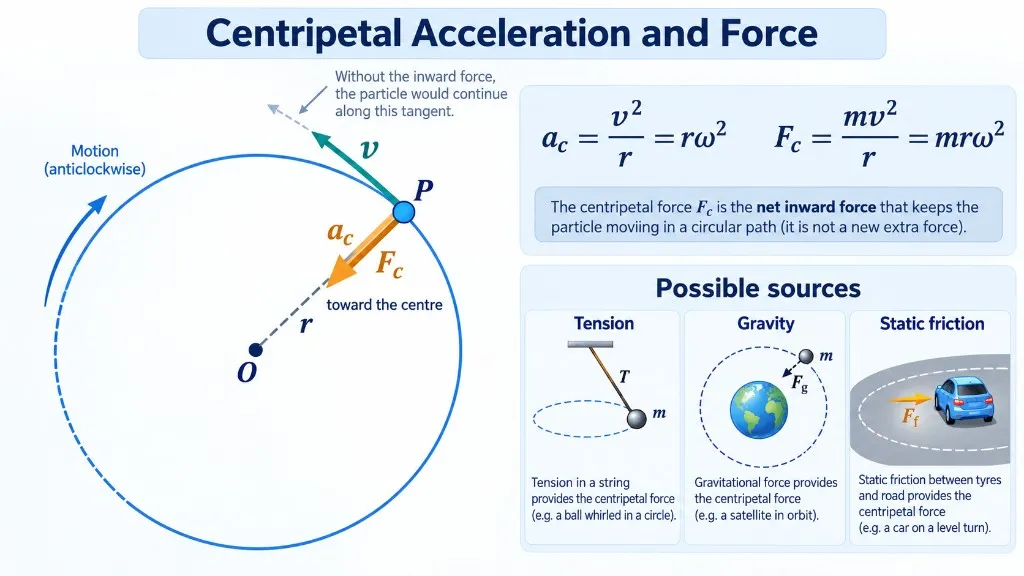
Keep these formulas available as searchable HTML:
ac = v²r = rω² Fc = mv² / r = mrω²
6. Derivation of Centripetal Acceleration
Consider a particle moving at constant speed v around a circle of radius r.
During a short time interval Δt:
- Its position vector changes by Δr.
- Its velocity changes by Δv.
- The position and velocity triangles are similar.
Therefore:
Δv / v = Δrr
Rearranging:
Δv = v Δrr
Dividing by Δt:
ΔvΔt = (vr) (ΔrΔt)
As:
Δt → 0
we have:
ΔvΔt → ac
and:
ΔrΔt → v
Therefore:
ac = (vr)(v) ac = v²r
7. Angular-Speed Form
The relation between linear and angular speed is:
v = rω
Substituting into:
ac = v²r
we get:
ac = (rω)² / r ac = r²ω²r
Therefore:
ac = rω²
8. Vector Form
The radial unit vector r̂ normally points outward.
Centripetal acceleration points inward.
Therefore:
a⃗c = −(v²r) r̂
or:
a⃗c = −rω² r̂
The negative sign represents the inward direction.
9. Units and Dimensions
SI Unit
m s⁻²
Dimensional Formula
[ac] = [LT⁻²]
This is the same dimensional formula as every other form of acceleration.
10. Important Relationships
ac = v²r
Therefore:
- If speed doubles, centripetal acceleration becomes four times greater.
- If speed triples, it becomes nine times greater.
- At constant speed, increasing radius decreases centripetal acceleration.
Using:
ac = rω²
we find that at constant angular speed, centripetal acceleration increases with radius.
11. Solved Example: Centripetal Acceleration
Question: A particle moves in a circle of radius 2 m with a speed of 6 m s⁻¹. Find its centripetal acceleration.
Given
r = 2 m v = 6 m s⁻¹
Formula
ac = v²r
Solution
ac = (6)² / 2 ac = 362 ac = 18 m s⁻²
Final Answer
ac = 18 m s⁻² toward the centre
4.2.1 Centripetal Force
12. Definition of Centripetal Force
13. Important Clarification
Centripetal force is not a separate or new type of force.
The term describes the role performed by the resultant inward force.
Depending on the situation, it may be provided by:
- Friction
- Tension
- Gravity
- Normal contact force
- Electric force
- Magnetic force
- A combination of forces
14. Derivation of Centripetal Force
According to Newton’s second law:
F = ma
For circular motion:
a = ac
Therefore:
Fc = mac
Using:
ac = v²r
we get:
Fc = mv² / r
Using:
ac = rω²
we get:
Fc = mrω²
15. Vector Form of Centripetal Force
Since the force is directed inward:
F⃗c = −(mv² / r) r̂
or:
F⃗c = −mrω² r̂
16. Unit and Dimensions
SI Unit
N
Dimensional Formula
[Fc] = [MLT⁻²]
17. Effect of Different Quantities
From:
Fc = mv² / r
Centripetal force is:
- Directly proportional to mass.
- Directly proportional to the square of speed.
- Inversely proportional to radius.
Therefore:
Fc ∝ m Fc ∝ v² Fc ∝ 1r
A small increase in speed causes a much larger increase in the required inward force.
18. Solved Example: Book-Based Car Problem
Question: The centripetal force on a car of mass 856 kg moving along a curve is 7250 N. If its speed is 12.0 m s⁻¹, find the curve’s radius.
Given
m = 856 kg Fc = 7250 N v = 12.0 m s⁻¹
Formula
Fc = mv² / r
Rearrangement
Fc r = mv² r = mv² / Fc
Solution
r = (856)(12.0)² / 7250 r = (856)1447250 r = 1232647250 r = 17.0 m
Final Answer
r ≈ 17.0 m
32. Centripetal and Tangential Quantities
Centripetal and Tangential Quantities
| Quantity | Direction | Main effect |
|---|---|---|
| Tangential velocity v | Tangent to path | Describes instantaneous motion |
| Centripetal acceleration a_c | Toward centre | Changes velocity direction |
| Centripetal force F_c | Toward centre | Produces centripetal acceleration |
| Tangential acceleration a_t | Along tangent | Changes speed |
33. Centripetal and Centrifugal Terms
In an inertial frame, the real force required for circular motion is inward and is called centripetal force.
An apparent outward effect may be described in a rotating frame using the term centrifugal force.
For standard Class 11 inertial-frame problems:
Σ Finward = mv² / r
Do not add an extra outward “centripetal” force.
34. Key Logic
An object naturally tends to continue along a straight-line tangent because of inertia.
A net inward force continuously changes the direction of its velocity.
Therefore:
- No inward force means no circular path.
- Greater speed requires much greater inward force.
- A smaller radius requires greater inward force.
- Centripetal force is supplied by an existing physical force.
35. Important Facts
- Constant speed does not mean constant velocity.
- Centripetal acceleration points inward.
- Tangential velocity is perpendicular to the radius.
- Centripetal force does not increase speed in uniform circular motion.
- Centripetal force is a role, not a new force.
- Friction may provide centripetal force on a level road.
- A normal-force component provides it on an ideal banked road.
- Tension provides it for some string-constrained motions.
- Gravity provides it in orbital motion.
- Mass cancels from the ideal banking-angle formula.
36. Tips and Tricks
- Draw or identify the inward radial direction first.
- Write Σ Finward = mv²/r.
- Do not automatically write T = mv²/r if other radial forces exist.
- Square the speed carefully.
- Convert all distances into metres.
- Use radius, not diameter.
- Keep angular velocity in rad s⁻¹.
- State “toward the centre” with acceleration and force answers.
- Separate vertical and horizontal equations on a banked curve.
37. Common Mistakes
- Saying acceleration is zero because speed is constant.
- Directing centripetal acceleration outward.
- Directing velocity toward the centre.
- Treating centripetal force as an additional force.
- Using diameter instead of radius.
- Forgetting the square of velocity.
- Assuming friction always acts opposite to the vehicle’s forward motion.
- Using N = mg on every banked surface.
- Ignoring other radial forces.
- Confusing centripetal and tangential acceleration.
38. Remember Box
39. Exam Facts
- Derivation of ac = v²r is important.
- Centripetal force is the resultant radial force.
- For a level turn, static friction can supply centripetal force.
- For an ideal banked curve: tan θ = v²r g
- For string-constrained horizontal circular motion: T = mv²/r when tension is the only radial force.
- Gravity provides centripetal force for an orbiting satellite.
- A centrifuge separates substances through rapid circular motion.
40. Short-Question Preparation
Short-Question Preparation
Q. Why is an object in uniform circular motion accelerating?
A. Its speed remains constant, but its velocity direction changes continuously. A change in either magnitude or direction of velocity represents acceleration. This acceleration points toward the centre and is called centripetal acceleration.
Q. Is centripetal force a new kind of force?
A. No. Centripetal force is the name given to the net inward force producing circular motion. It may be supplied by tension, friction, gravity, a normal force or another physical force. The source depends on the particular situation.
Q. What provides centripetal force on a level road?
A. Static friction between the tyres and road acts toward the centre of the curve. This friction changes the direction of the vehicle’s velocity and keeps it on the curved path. It does not necessarily act opposite to the vehicle’s forward motion.
Q. Why are roads banked?
A. Banking gives the normal force a horizontal component directed toward the curve’s centre. This component can provide some or all of the required centripetal force. The reliance on friction is therefore reduced at the designed speed.
41. Long-Question Preparation
Derive centripetal acceleration and force.
Consider an object moving with constant speed v around a circle. Its velocity is tangent to the path. During a short interval, its velocity changes by Δv. The position-vector and velocity-vector triangles are similar. Therefore: Δv / v = Δrr Rearranging: Δv = v Δrr Divide by Δt: ΔvΔt = (vr) (ΔrΔt) As Δt approaches zero: ΔvΔt → ac Also: ΔrΔt → v Therefore: ac = v²r Using v = rω: ac = rω² Newton’s second law gives: Fc = mac Therefore: Fc = mv² / r In angular form: F_c = mrω² Both centripetal acceleration and force point toward the centre.
42. MCQs
43. Sticky Notes
Sticky Notes
- Constant speed can still mean changing velocity.
- Velocity is tangent to the circle.
- Centripetal acceleration points inward.
- ac = v²r = rω²
- Fc = mv²/r = mrω²
- Centripetal force is the net inward force.
- Level curve: friction may provide F_c.
- Banked curve: normal-force component provides F_c.
- Orbit: gravity provides F_c.
- Use radius, not diameter.
44. 60-Second Revision
ac = v²r ac = rω² Fc = mv² / r Fc = mrω² For an ideal banked curve: tan θ = v²r g Main idea: Circular motion requires a resultant force directed toward the centre.
45. Topic Summary
Centripetal acceleration changes the direction of an object’s velocity and always points toward the centre of its circular path. The net force producing this acceleration is called centripetal force. It may be supplied by friction, tension, gravity, a normal force or another real force.
Next verified book topic: 4.3 Moment of Inertia
Exam Focus
Exam Focus
Important points
- Derivation of ac = v²r is important.
- Centripetal force is the resultant radial force.
- For a level turn, static friction can supply centripetal force.
- For an ideal banked curve: tan θ = v²r g
- Gravity provides centripetal force for an orbiting satellite.
Important formulas
- ac = v²r
- ac = rω²
- Fc = mv² / r
- Fc = mrω²
- tan θ = v²r g
- vmax = √(μs r g)
Common Mistakes
Common Mistakes
- Mistake
Saying acceleration is zero because speed is constant.
- Mistake
Directing centripetal acceleration outward.
- Mistake
Directing velocity toward the centre.
- Mistake
Treating centripetal force as an additional force.
- Mistake
Using diameter instead of radius.
- Mistake
Forgetting the square of velocity.
- Mistake
Assuming friction always acts opposite to the vehicle’s forward motion.
- Mistake
Using N = mg on every banked surface.
- Mistake
Ignoring other radial forces.
- Mistake
Confusing centripetal and tangential acceleration.
Revision Zone
60-Second Revision
Quick cues from this topic — use them for last-minute revision.
Constant speed can still mean changing velocity.
Velocity is tangent to the circle.
Centripetal acceleration points inward.
ac = v²r = rω²
The acceleration of an object moving in a circular path that is always directed toward the centre of the circle is called centripetal acceleration.
ac = v²r = rω² · Fc = mv²/r = mrω²
- Definition
- The acceleration of an object moving in a circular path that is always directed toward the centre of the circle is called centripetal acceleration.
- Formula
- ac = v²r = rω² · Fc = mv²/r = mrω²
- Critical warning
- Saying acceleration is zero because speed is constant.
Did you understand this topic?
Your answer is saved with your learning record. It does not mark the topic as mastered.
Ready to test yourself?
You've completed the learning section.
Exam Practice
Important Short Question
Q1. Why is an object in uniform circular motion accelerating?
Important Short Question
Q2. Is centripetal force a new kind of force?
Important Short Question
Q3. What provides centripetal force on a level road?
Important Short Question
Q4. Why are roads banked?
Long Question Preparation
Q5. Derive centripetal acceleration and force.