









16 min read
Elastic and Inelastic Collisions
In every isolated collision, total momentum remains conserved. An elastic collision also conserves total kinetic energy. In an inelastic collision, some kinetic energy changes into other forms. During a perfectly inelastic collision, objects remain together and move with a common velocity.
Choose Your Level
Recommended for Class 11
Elastic and Inelastic Collisions
Book Subtopics
- Meaning of collision
- Elastic collision
- Inelastic collision
- One-dimensional elastic collision
- Conservation of momentum
- Conservation of kinetic energy
- Relative speed of approach and separation
- Final velocities after elastic collision
- Special collision cases
1. Learning Outcomes
After studying this topic, students should be able to:
- Define a collision.
- Differentiate between elastic and inelastic collisions.
- Explain which quantities remain conserved.
- Apply momentum conservation to collision problems.
- Apply kinetic-energy conservation to elastic collisions.
- Derive the relative-velocity relation.
- Calculate the final velocities of two objects after an elastic collision.
- Explain important special cases involving equal and unequal masses.
- Solve perfectly inelastic collision problems.
- Explain why momentum may remain conserved while kinetic energy changes.
2. Definition of Collision
Examples include:
- Two laboratory carts interacting
- Two billiard balls striking each other
- A ball interacting with a bat
- Atomic and subatomic particle interactions
3. Types of Collisions
Collisions are mainly classified as:
- Elastic collisions
- Inelastic collisions
A special type of inelastic collision is called a perfectly inelastic collision.
4. Elastic Collision
An elastic collision is one in which both total momentum and total kinetic energy remain conserved.
Momentum Conservation
Σ p⃗i = Σ p⃗f
Kinetic-Energy Conservation
Σ Ki = Σ Kf
Ideal interactions between atomic or subatomic particles may be treated as elastic.
5. Inelastic Collision
An inelastic collision is one in which total momentum is conserved, but total kinetic energy is not conserved.
Σ p⃗i = Σ p⃗f
but:
Σ Ki ≠ Σ Kf
Some initial kinetic energy changes into other forms, such as:
- Thermal energy
- Sound energy
- Internal energy
- Deformation energy
The total energy remains conserved, but kinetic energy does not remain completely kinetic.
6. Perfectly Inelastic Collision
A perfectly inelastic collision occurs when the objects remain together after collision and move with a common velocity.
If the final common velocity is v:
m₁u₁ + m₂u₂ = (m₁ + m₂)v
Therefore:
v = m₁u₁ + m₂u₂m₁ + m₂
This type of collision produces the greatest loss of kinetic energy allowed by momentum conservation for the given initial conditions.
7. Diagram Placement
Elastic and Inelastic Collisions
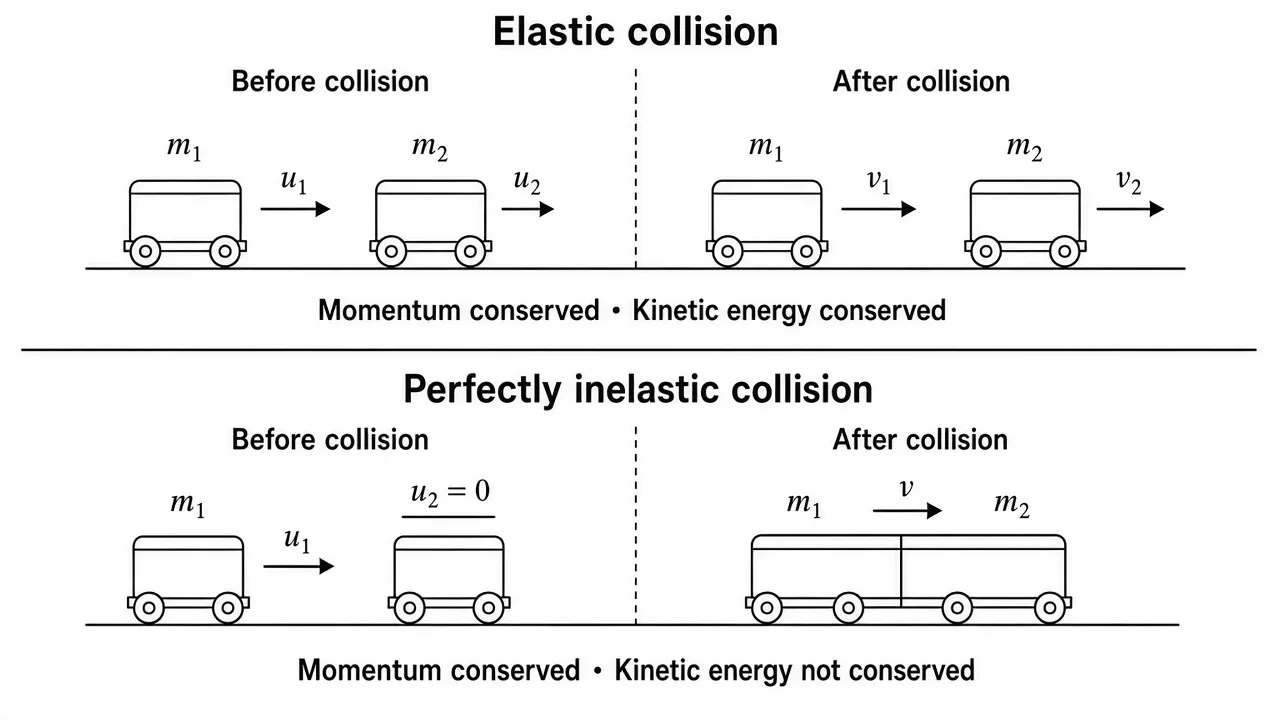
The definitions and equations must also remain available as searchable website text.
8. Elastic and Inelastic Collision Comparison
Elastic and Inelastic Collision Comparison
| Feature | Elastic collision | Inelastic collision |
|---|---|---|
| Momentum | Conserved | Conserved |
| Kinetic energy | Conserved | Not conserved |
| Objects after interaction | Normally separate | May separate or remain together |
| Permanent deformation | Ideally absent | May occur |
| Energy transformation | No net loss of kinetic energy | Some kinetic energy changes form |
| Example | Ideal billiard-ball interaction | Soft objects interacting |
| Common final velocity | Not necessary | Only in a perfectly inelastic collision |
9. Important Clarification
All perfectly inelastic collisions are inelastic.
However, not every inelastic collision is perfectly inelastic.
In an ordinary inelastic collision, the objects may separate afterward.
In a perfectly inelastic collision, they remain together.
3.4.1 One-Dimensional Elastic Collision
10. Initial Conditions
Consider two objects with:
- Masses m₁ and m₂
- Initial velocities u₁ and u₂
- Final velocities v₁ and v₂
Their motion occurs along the same straight line.
Take rightward velocity as positive and leftward velocity as negative.
11. Conservation of Momentum
For an isolated system:
Initial momentum = Final momentum
Therefore:
m₁u₁ + m₂u₂ = m₁v₁ + m₂v₂
Rearranging:
m₁u₁ − m₁v₁ = m₂v₂ − m₂u₂
Taking common factors:
m₁(u₁ − v₁) = m₂(v₂ − u₂)
12. Conservation of Kinetic Energy
For an elastic collision:
Initial kinetic energy = Final kinetic energy
Therefore:
½ m₁u₁² + ½ m₂u₂² = ½ m₁v₁² + ½ m₂v₂²
Multiplying by 2:
m₁u₁² + m₂u₂² = m₁v₁² + m₂v₂²
Rearranging:
m₁(u₁² − v₁²) = m₂(v₂² − u₂²)
Using the difference of squares:
m₁(u₁ − v₁)(u₁ + v₁) = m₂(v₂ − u₂)(v₂ + u₂)
13. Relative Speed Relation
From momentum conservation:
m₁(u₁ − v₁) = m₂(v₂ − u₂)
From kinetic-energy conservation:
m₁(u₁ − v₁)(u₁ + v₁) = m₂(v₂ − u₂)(v₂ + u₂)
Dividing the second equation by the first:
u₁ + v₁ = v₂ + u₂
Rearranging:
u₁ − u₂ = v₂ − v₁
Therefore:
Relative speed of approach = Relative speed of separation
This relation applies to a one-dimensional elastic collision.
14. Physical Meaning of Relative Speed
Before collision, the relative speed of approach is:
u₁ − u₂
After collision, the relative speed of separation is:
v₂ − v₁
For a perfectly elastic collision:
u₁ − u₂ = v₂ − v₁
The relation uses velocities with signs, not just positive speed values.
15. Final Velocity of the First Object
The final velocity of mass m₁ is:
v₁ = (m₁ − m₂m₁ + m₂) u₁ + (2m₂/(m₁ + m₂)) u₂
It can also be written as:
v₁ = (m₁ − m₂)u₁ + 2m₂u₂m₁ + m₂
16. Final Velocity of the Second Object
The final velocity of mass m₂ is:
v₂ = (2m₁/(m₁ + m₂)) u₁ + (m₂ − m₁m₁ + m₂) u₂
It can also be written as:
v₂ = 2m₁u₁ + (m₂ − m₁)u₂m₁ + m₂
17. Symbols and Units
Symbols and Units
| Quantity | Meaning | SI unit |
|---|---|---|
| m₁ | Mass of first object | kg |
| m₂ | Mass of second object | kg |
| u₁ | Initial velocity of first object | m s⁻¹ |
| u₂ | Initial velocity of second object | m s⁻¹ |
| v₁ | Final velocity of first object | m s⁻¹ |
| v₂ | Final velocity of second object | m s⁻¹ |
| p | Momentum | kg m s⁻¹ |
| K | Kinetic energy | J |
Special Cases of Elastic Collisions
18. Case 1: Objects Have Equal Masses
If:
m₁ = m₂
Then:
v₁ = u₂
and:
v₂ = u₁
The objects exchange their velocities.
19. Case 2: Equal Masses and Target Initially at Rest
If:
m₁ = m₂
and:
u₂ = 0
Then:
v₁ = 0
and:
v₂ = u₁
The first object stops, while the second object moves with the first object’s initial velocity.
This behaviour can be approximately observed with identical laboratory carts or ideal billiard balls.
20. Case 3: Light Object Strikes a Very Massive Stationary Object
If:
m₂ ≫ m₁
and:
u₂ = 0
Then approximately:
v₁ ≈ −u₁
and:
v₂ ≈ 0
The light object rebounds with almost the same speed in the opposite direction.
The massive object experiences a negligible change in velocity.
21. Case 4: Very Massive Object Strikes a Light Stationary Object
If:
m₁ ≫ m₂
and:
u₂ = 0
Then approximately:
v₁ ≈ u₁
and:
v₂ ≈ 2u₁
The massive object continues with nearly its original velocity.
The light object may move with nearly twice the massive object’s initial velocity.
These are limiting approximations for a perfectly elastic interaction.
22. Book-Based Solved Example: Elastic Collision
Question: A 5 kg object moving at 10 m s⁻¹ interacts elastically with a 10 kg object moving in the same direction at 5 m s⁻¹. Find their final velocities.
Given
m₁ = 5 kg u₁ = 10 m s⁻¹ m₂ = 10 kg u₂ = 5 m s⁻¹
Final Velocity of the First Object
v₁ = (m₁ − m₂m₁ + m₂) u₁ + (2m₂/(m₁ + m₂)) u₂ v₁ = (5 − 105 + 10)(10) + (2105 + 10)(5) v₁ = (−515)(10) + (2015)(5) v₁ = −5015 + 10015 v₁ = 5015 v₁ = 3.33 m s⁻¹
Final Velocity of the Second Object
v₂ = (2m₁/(m₁ + m₂)) u₁ + (m₂ − m₁m₁ + m₂) u₂ v₂ = (255 + 10)(10) + (10 − 55 + 10)(5) v₂ = (1015)(10) + (515)(5) v₂ = 10015 + 2515 v₂ = 12515 v₂ = 8.33 m s⁻¹
Final Answers
v₁ = 3.33 m s⁻¹ v₂ = 8.33 m s⁻¹
23. Verification of Momentum
Initial Momentum
pi = m₁u₁ + m₂u₂ pi = (5)(10) + (10)(5) pi = 50 + 50 pi = 100 kg m s⁻¹
Final Momentum
Using unrounded final velocities:
pf = m₁v₁ + m₂v₂ pf = 100 kg m s⁻¹
Therefore:
pi = pf
Small differences may appear if rounded velocities are substituted too early.
24. Solved Example: Perfectly Inelastic Collision
Question: A 3 kg cart moving right at 8 m s⁻¹ interacts with a stationary 5 kg cart. They remain together. Find their common velocity.
Given
m₁ = 3 kg u₁ = 8 m s⁻¹ m₂ = 5 kg u₂ = 0
Formula
m₁u₁ + m₂u₂ = (m₁ + m₂)v
Solution
(3)(8) + (5)(0) = (3 + 5)v 24 = 8v v = 3 m s⁻¹
Final Answer
v = 3 m s⁻¹ rightward
25. Kinetic-Energy Check
Initial Kinetic Energy
Ki = ½ m₁u₁² Ki = ½(3)(8)² Ki = ½(3)(64) Ki = 96 J
Final Kinetic Energy
Kf = ½(m₁ + m₂)v² Kf = ½(8)(3)² Kf = 4(9) Kf = 36 J
Change in Kinetic Energy
ΔK = Kf − Ki ΔK = 36 − 96 ΔK = −60 J
The negative sign shows that 60 J of kinetic energy changed into other forms.
Total energy remains conserved.
26. Key Logic
In Every Isolated Collision
Momentum is conserved
Only in an Elastic Collision
Kinetic energy is also conserved
In a Perfectly Inelastic Collision
Objects move together afterward
Therefore, begin every collision problem with momentum conservation. Apply kinetic-energy conservation only when the collision is stated to be elastic.
27. Coefficient of Restitution
The coefficient of restitution is sometimes used to classify collisions.
However, according to the learning scope of this chapter, detailed knowledge or calculation of the coefficient of restitution is not required.
Students should focus on:
- Momentum conservation
- Kinetic-energy conservation
- Relative speed of approach
- Relative speed of separation
28. Real-Life Applications
Collision principles are useful in:
- Laboratory-cart experiments
- Billiard and snooker-ball motion
- Ball-and-bat interactions
- Vehicle-safety analysis
- Particle-physics experiments
- Packaging and protective materials
- Sports-equipment design
29. Important Facts
- Momentum is conserved in every isolated collision.
- Kinetic energy is conserved only in an elastic collision.
- Total energy is always conserved.
- A perfectly inelastic collision has a common final velocity.
- Equal masses exchange velocities in a one-dimensional elastic collision.
- A velocity’s negative sign indicates direction.
- Objects do not need to remain together in every inelastic collision.
- Relative speed of approach equals relative speed of separation only for an elastic collision.
30. Tips and Tricks
- Select the positive direction before writing velocities.
- Convert all masses into kilograms.
- Use negative values for motion opposite to the positive direction.
- Apply momentum conservation first.
- Use kinetic-energy conservation only for elastic collisions.
- Use a common final velocity only if the objects remain together.
- Retain calculator values until the final answer.
- Verify elastic-collision answers using both conservation laws.
- Interpret negative final velocity as reversed direction.
31. Common Mistakes
- Assuming kinetic energy is conserved in every collision.
- Assuming objects always remain together in an inelastic collision.
- Ignoring velocity directions.
- Adding speeds instead of signed velocities.
- Confusing total energy with kinetic energy.
- Applying elastic final-velocity formulas to an inelastic collision.
- Forgetting the square of velocity in kinetic energy.
- Rounding final velocities too early.
- Using a common velocity when objects separate.
- Treating momentum as a scalar.
32. Remember Box
33. Exam Facts
- Collision forces are internal forces within the selected system.
- Elastic collision conserves momentum and kinetic energy.
- Inelastic collision conserves momentum but not kinetic energy.
- Perfectly inelastic objects remain together.
- Equal masses exchange velocities during a one-dimensional elastic collision.
- Relative approach and separation speeds are equal in an elastic collision.
- A negative final velocity means reversed direction.
- Final-velocity formulas apply to one-dimensional elastic collisions.
34. Short-Question Preparation
Short-Question Preparation
Q. Differentiate between elastic and inelastic collisions.
A. In an elastic collision, both total momentum and total kinetic energy remain conserved. In an inelastic collision, momentum remains conserved but kinetic energy does not. Some kinetic energy changes into thermal, sound, internal or deformation energy. Objects may separate after either type of collision. Remaining together is specific to a perfectly inelastic collision.
Q. What is a perfectly inelastic collision?
A. A perfectly inelastic collision is one in which interacting objects remain together afterward. They move with a common final velocity. Total momentum remains conserved if the system is isolated. Kinetic energy is not conserved. The common velocity is found using momentum conservation.
Q. What happens when identical objects collide elastically?
A. In a one-dimensional elastic collision, two identical objects exchange their velocities. If the second object is initially stationary, the first object stops after collision. The second object then moves with the first object’s original velocity. Both momentum and kinetic energy remain conserved.
Q. Why is kinetic energy not conserved in an inelastic collision?
A. During an inelastic collision, part of the initial kinetic energy changes into other forms. These may include thermal, sound, internal or deformation energy. The total amount of energy remains conserved. However, the total kinetic energy after collision is smaller than before collision.
35. Long-Question Preparation
Derive the relative-speed relation for an elastic collision.
Consider two objects moving along one straight line. Their masses are m₁ and m₂. Their initial velocities are u₁ and u₂. Their final velocities are v₁ and v₂. Momentum conservation gives: m₁u₁ + m₂u₂ = m₁v₁ + m₂v₂ Rearranging: m₁(u₁ − v₁) = m₂(v₂ − u₂) Kinetic-energy conservation gives: ½ m₁u₁² + ½ m₂u₂² = ½ m₁v₁² + ½ m₂v₂² Multiplying by two and rearranging: m₁(u₁² − v₁²) = m₂(v₂² − u₂²) Factoring the differences of squares: m₁(u₁ − v₁)(u₁ + v₁) = m₂(v₂ − u₂)(v₂ + u₂) Divide this equation by the rearranged momentum equation. The common terms cancel: u₁ + v₁ = v₂ + u₂ Rearranging gives: u₁ − u₂ = v₂ − v₁ The left side is the relative speed of approach. The right side is the relative speed of separation. Hence, both relative speeds are equal in an elastic collision.
36. MCQs
37. Practice Questions
Beginner
- Define collision.
- Define an elastic collision.
- Define an inelastic collision.
- What is a perfectly inelastic collision?
- Which quantity is conserved in every isolated collision?
Intermediate
- Two equal-mass carts interact elastically. One is initially stationary. Explain their final motion.
- A 2 kg cart moving at 6 m s⁻¹ remains attached to a stationary 4 kg cart. Find their common velocity.
- Calculate the initial and final kinetic energies for Question 2.
- State the relative-speed relation for an elastic collision.
- Explain why momentum conservation does not guarantee kinetic-energy conservation.
Advanced
- Derive the final-velocity formulas for a one-dimensional elastic collision.
- Derive the relative-speed relation.
- Explain all four special cases described in the textbook.
- Verify momentum and kinetic-energy conservation for an elastic-collision result.
- Compare elastic, inelastic and perfectly inelastic collisions.
38. Practice Answer Key
For the 2 kg cart moving at 6 m s⁻¹ and the stationary 4 kg cart: m₁u₁ + m₂u₂ = (m₁ + m₂)v (2)(6) + (4)(0) = (2 + 4)v 12 = 6v v = 2 m s⁻¹ Initial kinetic energy: Ki = ½(2)(6)² Ki = 36 J Final kinetic energy: Kf = ½(6)(2)² Kf = 12 J Kinetic-energy change: ΔK = 12 − 36 ΔK = −24 J Momentum is conserved, while 24 J of kinetic energy changes into other forms.
39. Sticky Notes
Sticky Notes
- Elastic: momentum and kinetic energy conserved.
- Inelastic: momentum conserved, kinetic energy not conserved.
- Perfectly inelastic: objects remain together.
- Equal elastic masses exchange velocities.
- Velocity signs represent directions.
- Begin collision problems with momentum conservation.
- Use kinetic-energy conservation only when the collision is elastic.
- Avoid early rounding.
40. 60-Second Revision
Momentum conservation: m₁u₁ + m₂u₂ = m₁v₁ + m₂v₂ Elastic-collision kinetic energy: ½ m₁u₁² + ½ m₂u₂² = ½ m₁v₁² + ½ m₂v₂² Relative-speed relation: u₁ − u₂ = v₂ − v₁ Perfectly inelastic common velocity: v = m₁u₁ + m₂u₂m₁ + m₂
41. Topic Summary
In every isolated collision, total momentum remains conserved. An elastic collision also conserves total kinetic energy. In an inelastic collision, some kinetic energy changes into other forms. During a perfectly inelastic collision, objects remain together and move with a common velocity.
Exam Focus
Exam Focus
Important points
- Collision forces are internal forces within the selected system.
- Elastic collision conserves momentum and kinetic energy.
- Inelastic collision conserves momentum but not kinetic energy.
- Perfectly inelastic objects remain together.
- Equal masses exchange velocities during a one-dimensional elastic collision.
- Relative approach and separation speeds are equal in an elastic collision.
Important formulas
- m₁u₁ + m₂u₂ = m₁v₁ + m₂v₂
- ½ m₁u₁² + ½ m₂u₂² = ½ m₁v₁² + ½ m₂v₂²
- u₁ − u₂ = v₂ − v₁
- v = m₁u₁ + m₂u₂m₁ + m₂
Common Mistakes
Common Mistakes
- Mistake
Assuming kinetic energy is conserved in every collision.
- Mistake
Assuming objects always remain together in an inelastic collision.
- Mistake
Ignoring velocity directions.
- Mistake
Adding speeds instead of signed velocities.
- Mistake
Confusing total energy with kinetic energy.
- Mistake
Applying elastic final-velocity formulas to an inelastic collision.
- Mistake
Forgetting the square of velocity in kinetic energy.
- Mistake
Rounding final velocities too early.
- Mistake
Using a common velocity when objects separate.
- Mistake
Treating momentum as a scalar.
Revision Zone
60-Second Revision
Quick cues from this topic — use them for last-minute revision.
Momentum conserved in every isolated collision
Kinetic energy conserved only in elastic collisions
u₁ − u₂ = v₂ − v₁ for 1D elastic
v = m₁u₁ + m₂u₂m₁ + m₂ when objects stick
A collision is a short-duration interaction between two objects during which they exert relatively large forces on each other and exchange momentum.
m₁u₁ + m₂u₂ = m₁v₁ + m₂v₂
- Definition
- A collision is a short-duration interaction between two objects during which they exert relatively large forces on each other and exchange momentum.
- Formula
- m₁u₁ + m₂u₂ = m₁v₁ + m₂v₂
- Critical warning
- Assuming kinetic energy is conserved in every collision.
Did you understand this topic?
Your answer is saved with your learning record. It does not mark the topic as mastered.
Ready to test yourself?
You've completed the learning section.
Practice
Beginner
Q1. Define collision.
Beginner
Q2. Define an elastic collision.
Beginner
Q3. Define an inelastic collision.
Beginner
Q4. What is a perfectly inelastic collision?
Beginner
Q5. Which quantity is conserved in every isolated collision?
Intermediate
Q6. Two equal-mass carts interact elastically. One is initially stationary. Explain their final motion.
Intermediate
Q7. A 2 kg cart moving at 6 m s⁻¹ remains attached to a stationary 4 kg cart. Find their common velocity.
Intermediate
Q8. Calculate the initial and final kinetic energies for Question 2.
Intermediate
Q9. State the relative-speed relation for an elastic collision.
Intermediate
Q10. Explain why momentum conservation does not guarantee kinetic-energy conservation.
Advanced
Q11. Derive the final-velocity formulas for a one-dimensional elastic collision.
Advanced
Q12. Derive the relative-speed relation.
Advanced
Q13. Explain all four special cases described in the textbook.
Advanced
Q14. Verify momentum and kinetic-energy conservation for an elastic-collision result.
Advanced
Q15. Compare elastic, inelastic and perfectly inelastic collisions.
Exam Practice
Important Short Question
Q1. Differentiate between elastic and inelastic collisions.
Important Short Question
Q2. What is a perfectly inelastic collision?
Important Short Question
Q3. What happens when identical objects collide elastically?
Important Short Question
Q4. Why is kinetic energy not conserved in an inelastic collision?
Long Question Preparation
Q5. Derive the relative-speed relation for an elastic collision.