









12 min read
Equations of Uniformly Accelerated Motion
The equations of uniformly accelerated motion describe straight-line motion with constant acceleration. The first equation relates velocity and time, the second relates displacement and time, and the third relates velocity and displacement without using time. The same equations describe free fall when acceleration is replaced by +g or −g according to the chosen sign convention.
Choose Your Level
Recommended for Class 11
Equations of Uniformly Accelerated Motion
Subtopics
- First Equation of Motion
- Second Equation of Motion
- Third Equation of Motion
- Free-Fall Motion
1. Learning Outcomes
After studying this topic, students should be able to:
- Define uniformly accelerated motion.
- Identify initial velocity, final velocity, acceleration, time, and displacement.
- State and derive the three equations of motion.
- Select the correct equation for a given numerical problem.
- Use an appropriate sign convention.
- Apply the equations to accelerating and decelerating objects.
- Explain free fall and acceleration due to gravity.
- Solve problems involving dropped and vertically projected objects.
2. Definition
3. Conditions for Using the Equations
The three equations of motion can be applied when:
- Acceleration is constant.
- Motion occurs along a straight line.
- All quantities are measured in a consistent unit system.
- A clear positive direction has been selected.
They should not be applied directly when acceleration continuously changes.
4. Key Terms
Initial Velocity
The velocity at the beginning of the selected time interval. u = initial velocity
Final Velocity
The velocity at the end of the selected time interval. v = final velocity
Acceleration
The rate of change of velocity. a = v − ut
Time
The duration for which the motion is studied. t = time interval
Displacement
The change in the object’s position in a particular direction. s = displacement
Deceleration
Acceleration acting opposite to the selected positive direction. It is represented by a negative value of a.
5. Symbols and SI Units
Symbols and SI Units
| Quantity | Symbol | SI unit |
|---|---|---|
| Initial velocity | u | m s⁻¹ |
| Final velocity | v | m s⁻¹ |
| Acceleration | a | m s⁻² |
| Time | t | s |
| Displacement | s | m |
| Acceleration due to gravity | g | m s⁻² |
| Vertical height | h | m |
6. Main Equations of Motion
First Equation
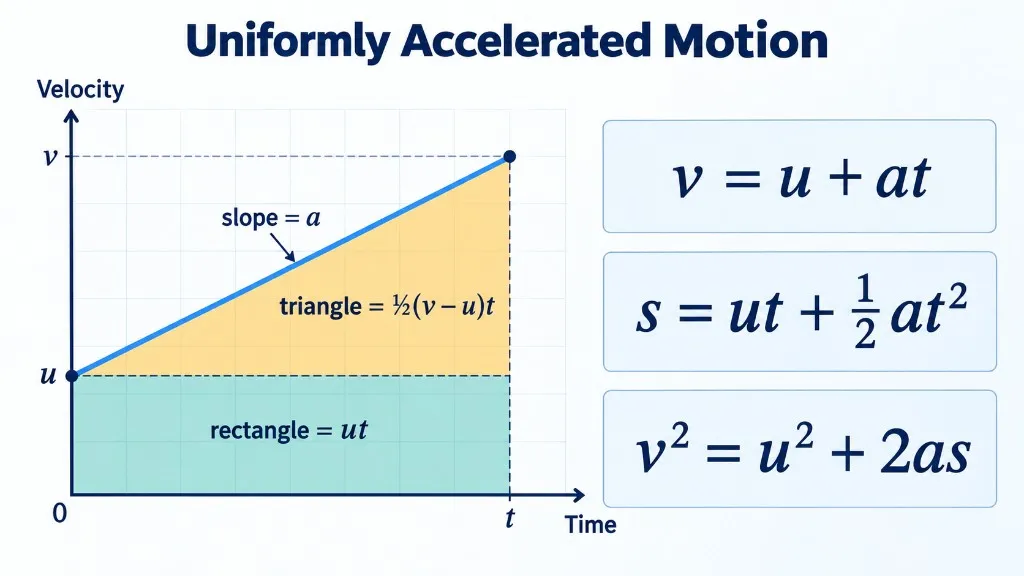
v = u + at
Second Equation
s = ut + ½at²
Third Equation
v² = u² + 2as
Average-Velocity Relation
s = (u + v2) t
Uniformly Accelerated Motion
18. Formula-Selection Guide
Formula-Selection Guide
| Missing quantity | Best equation |
|---|---|
| Displacement s is not given or required | v = u + at |
| Final velocity v is not given or required | s = ut + ½at² |
| Time t is not given or required | v² = u² + 2as |
| Acceleration a is not required | s = (u + v2) t |
Quick Method
- Write all known quantities.
- Identify the required quantity.
- Identify the quantity that is completely absent.
- Select the equation that does not contain the absent quantity.
28. Important Facts
- The equations apply only to constant acceleration.
- Deceleration is represented by negative acceleration.
- Displacement and distance are not always identical.
- A negative velocity indicates direction.
- Gravity always acts downward.
- At maximum height, vertical velocity is zero.
- Acceleration at maximum height is still g downward.
- In ideal free fall, objects of different masses have the same acceleration.
- An object returning to its launch level has the same speed as its initial speed when air resistance is ignored.
- Its final velocity has the opposite direction to its initial velocity.
29. Key Logic
The equations of motion do not change during free fall. Only the symbols and signs are adjusted: a → g or: a → −g The sign depends on the selected positive direction. Never memorize gravity as always negative. Gravity is negative only when upward has been selected as positive.
30. Real-Life Applications
These equations are used to study:
- Accelerating vehicles
- Braking and stopping distance
- Objects dropped from buildings
- Vertically thrown balls
- Lift and elevator motion
- Runway motion of aircraft
- Motion of trains
- Laboratory trolley experiments
- Objects moving on straight inclined paths
- Short vertical motion near Earth’s surface
31. Tips and Tricks
- Write u, v, a, t, s before choosing an equation.
- Convert kilometres per hour into metres per second when required.
- Select the positive direction before inserting signs.
- Use u = 0 only when an object actually starts from rest.
- Use v = 0 at the highest point of vertical motion.
- Use negative acceleration for slowing motion only when acceleration opposes the positive direction.
- Never mix upward-positive and downward-positive equations in one calculation.
- Use the positive root for elapsed time unless the negative root has a relevant mathematical meaning.
- Include both magnitude and direction in velocity answers.
32. Common Mistakes
- Applying the equations when acceleration is not constant.
- Confusing initial and final velocity.
- Writing g = 0 at the highest point.
- Treating displacement as always positive.
- Using a positive acceleration for braking without considering direction.
- Forgetting the square on t in the second equation.
- Forgetting the square on u and v in the third equation.
- Mixing g = 9.8 m s⁻² and g = 10 m s⁻² in one problem.
- Writing the velocity unit as m s⁻².
- Giving two positive times for an upward-and-downward journey without interpreting them.
33. Remember Box
34. Exam Facts
- The first equation does not contain displacement.
- The second equation does not contain final velocity.
- The third equation does not contain time.
- The area under a velocity–time graph represents displacement.
- The slope of a velocity–time graph represents acceleration.
- At maximum height, v = 0, but a = −g when upward is positive.
- A dropped object has u = 0.
- Negative acceleration does not always mean that an object is slowing down; directions must be compared.
- Use one consistent sign convention throughout a solution.
35. Short-Question Preparation
Short-Question Preparation
Q. What is uniformly accelerated motion?
A. Uniformly accelerated motion is motion in which velocity changes by equal amounts in equal time intervals. Its acceleration remains constant. The motion may involve an increase or decrease in velocity. The standard equations of motion can be applied to it. These equations normally describe straight-line motion.
Q. State the three equations of motion.
A. The three equations are v = u + at, s = ut + ½at², and v² = u² + 2as. They relate initial velocity, final velocity, acceleration, time, and displacement. Each equation excludes one of these quantities. They are valid only for constant acceleration.
Q. What is free fall?
A. Free fall is the motion of an object under the influence of gravity alone. Air resistance is ignored in ideal free-fall problems. Near Earth’s surface, the acceleration is approximately 9.8 m s⁻² downward. All objects have the same ideal free-fall acceleration regardless of mass.
Q. Is acceleration zero at maximum height?
A. No, acceleration is not zero at maximum height. Only the instantaneous vertical velocity becomes zero there. Gravity continues to act on the object in the downward direction. Therefore, its acceleration remains equal to g downward. This acceleration causes the object to begin moving downward.
36. Long-Question Preparation
Derive the three equations of uniformly accelerated motion.
Consider an object moving with constant acceleration a. Let its initial velocity be u. Let its final velocity after time t be v. Acceleration is the rate of change of velocity: a = v − ut Rearranging gives: v = u + at This is the first equation of motion. For constant acceleration, average velocity is: v_avg = u + v2 Displacement is average velocity multiplied by time: s = (u + v2) t Substituting v = u + at: s = (u + (u + at)) / 2 × t Simplifying gives: s = ut + ½at² This is the second equation. From the first equation: t = v − ua Substitute this value into the average-velocity relation: s = (u + v2) × (v − ua) Therefore: 2as = (u + v)(v − u) Using the difference of squares: 2as = v² − u² Rearranging gives: v² = u² + 2as This is the third equation of motion. All three equations require constant acceleration.
40. Sticky Notes
Sticky Notes
- Constant acceleration is required.
- First equation excludes s.
- Second equation excludes v.
- Third equation excludes t.
- Dropped from rest means u = 0.
- At maximum height, v = 0.
- Gravity remains downward throughout the motion.
- Choose a sign convention before substitution.
- Use one calculation step per line.
- Always write the final unit and direction.
41. Quick Revision
v = u + at s = ut + ½at² v² = u² + 2as s = (u + v2) t For an object dropped from rest: v = gt h = ½gt² v² = 2gh
42. 60-Second Revision
- List the known and required quantities.
- Select a positive direction.
- Insert the correct signs.
- Choose the equation that excludes the unwanted quantity.
- For upward-positive free fall, use a = −g.
- For downward-positive falling motion, use a = +g.
- At maximum height, use v = 0, not g = 0.
- Check units and direction in the final answer.
43. Topic Summary
The equations of uniformly accelerated motion describe straight-line motion with constant acceleration. The first equation relates velocity and time, the second relates displacement and time, and the third relates velocity and displacement without using time. The same equations describe free fall when acceleration is replaced by +g or −g according to the chosen sign convention.
44. Suggested Ask-the-Tutor Questions
- How do I select the correct equation of motion?
- Why is acceleration negative during braking?
- Why is gravity not zero at maximum height?
- How do I choose a sign convention for free fall?
- What is the difference between a dropped and projected object?
- How are the equations derived from a velocity–time graph?
45. References
- Prescribed Class 11 Physics textbook
- Official Class 11 Physics curriculum
- School physics laboratory manual
- Teacher-provided classroom notes
Exam Focus
Exam Focus
Important points
- The first equation does not contain displacement.
- The second equation does not contain final velocity.
- The third equation does not contain time.
- The area under a velocity–time graph represents displacement.
- The slope of a velocity–time graph represents acceleration.
- At maximum height, v = 0, but a = −g when upward is positive.
- A dropped object has u = 0.
- Negative acceleration does not always mean that an object is slowing down; directions must be compared.
- Use one consistent sign convention throughout a solution.
Important formulas
- v = u + at
- s = ut + ½at²
- v² = u² + 2as
- s = (u + v2) t
Common exam traps
- Writing g = 0 at the highest point.
- Mixing g = 9.8 m s⁻² and g = 10 m s⁻² in one problem.
Common Mistakes
Common Mistakes
- Mistake
Applying the equations when acceleration is not constant.
- Mistake
Confusing initial and final velocity.
- Mistake
Writing g = 0 at the highest point.
- Mistake
Treating displacement as always positive.
- Mistake
Using a positive acceleration for braking without considering direction.
- Mistake
Forgetting the square on t in the second equation.
- Mistake
Forgetting the square on u and v in the third equation.
- Mistake
Mixing g = 9.8 m s⁻² and g = 10 m s⁻² in one problem.
- Mistake
Writing the velocity unit as m s⁻².
- Mistake
Giving two positive times for an upward-and-downward journey without interpreting them.
Revision Zone
60-Second Revision
Quick cues from this topic — use them for last-minute revision.
v = u + at
s = ut + ½at²
v² = u² + 2as
s = (u + v2) t
Motion in which the velocity of an object changes by equal amounts in equal intervals of time is called uniformly accelerated motion.
v = u + at; s = ut + ½at²; v² = u² + 2as
- Definition
- Motion in which the velocity of an object changes by equal amounts in equal intervals of time is called uniformly accelerated motion.
- Formula
- v = u + at; s = ut + ½at²; v² = u² + 2as
- Example
- For free fall, replace a with +g or −g according to the selected positive direction.
- Critical warning
- Writing g = 0 at the highest point.
Did you understand this topic?
Your answer is saved with your learning record. It does not mark the topic as mastered.
Ready to test yourself?
You've completed the learning section.
Practice
Practice
Q1. Define uniformly accelerated motion.
Practice
Q2. State the three equations of motion.
Practice
Q3. Explain the symbols u, v, a, t, s.
Exam Practice
Important Short Question
Q1. What is uniformly accelerated motion?
Important Short Question
Q2. State the three equations of motion.
Long Question Preparation
Q3. Derive the three equations of uniformly accelerated motion.