









PhysicsChapter 3: Translatory Motion
Free-Fall Motion
19. Definition of Free Fall
20. Acceleration Due to Gravity
Near Earth’s surface, all freely falling objects have approximately the same downward acceleration: g ≈ 9.8 m s⁻² For simplified numerical questions, the value may be given as: g = 10 m s⁻² The direction of g is always vertically downward. An object’s mass does not affect its free-fall acceleration when air resistance is ignored.
21. Free-Fall Assumptions
Standard free-fall equations normally assume that:
- Air resistance is negligible.
- Gravity is the only force acting on the object.
- The value of g remains constant.
- Motion occurs close to Earth’s surface.
- The object moves vertically.
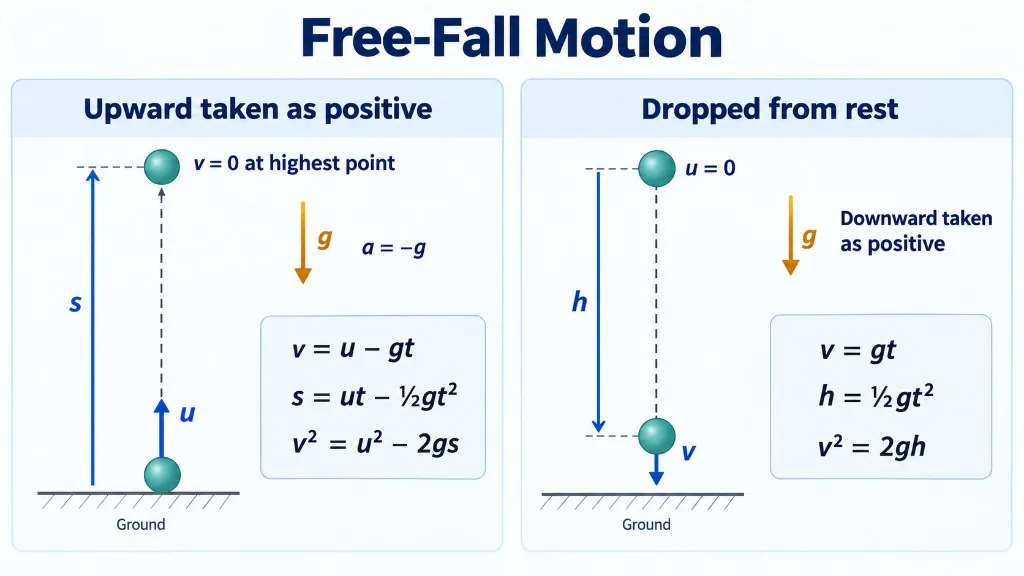
22. Free-Fall Sign Convention
A positive direction must be selected before solving the problem.
When Upward Is Positive
a = −g For an object projected upward: v = u − gt s = ut − ½gt² v² = u² − 2gs
When Downward Is Positive
a = +g For an object dropped from rest: u = 0 v = gt h = ½gt² v² = 2gh
Free-Fall Motion
23. Important Free-Fall Cases
Object Dropped From Rest
u = 0 Taking downward as positive: v = gt h = ½gt² v² = 2gh
Object Projected Vertically Upward
Taking upward as positive: a = −g v = u − gt s = ut − ½gt² v² = u² − 2gs
At the Highest Point
v = 0 However: a = −g The velocity is momentarily zero, but acceleration is not zero.
24. Time to Reach Maximum Height
At maximum height: v = 0 Using: v = u − gt Substituting v = 0: 0 = u − gt gt = u tup = ug If the object returns to the same level: ttotal = 2u / g
25. Maximum Height
At maximum height: v = 0 Using: v² = u² − 2gh Substituting v = 0: 0 = u² − 2gh 2gh = u² h_max = u²2g
26. Solved Example 4: Object Dropped From Rest
Solved Example 4: Object Dropped From Rest
An object is dropped from a height of 45 m. Calculate its time of fall and final velocity. Take g = 10 m s⁻².
- u = 0
- h = 45 m
- g = 10 m s⁻²
- Downward is taken as positive.
Time of Fall: h = ½gt²
45 = ½(10)t²
45 = 5t²
t² = 9
t = 3 s
Final Velocity: v = gt
v = (10)(3)
v = 30 m s⁻¹
Final answer: t = 3 s; v = 30 m s⁻¹ downward
27. Solved Example 5: Object Projected Upward
Solved Example 5: Object Projected Upward
A ball is projected vertically upward with an initial velocity of 20 m s⁻¹. Calculate its time to reach maximum height, maximum height, and total time of flight. Take g = 10 m s⁻².
- u = 20 m s⁻¹
- g = 10 m s⁻²
- At maximum height: v = 0
Time to Reach Maximum Height: tup = ug = 2010 = 2 s
Maximum Height: hmax = u²2g = (20)² / (2 × 10) = 40020 = 20 m
Total Time: ttotal = 2 tup = 2(2) = 4 s
Final answer: tup = 2 s; hmax = 20 m; ttotal = 4 s
Did you understand this topic?
Your answer is saved with your learning record. It does not mark the topic as mastered.
Exam preparation
Exam Focus
Same supplied content as this Notes page (shared canonical source).