









PhysicsChapter 3: Translatory Motion
Projectile Motion
Book Subtopics
- Projectile launched horizontally
- Projectile launched at an angle
- Maximum height
- Time of flight
- Time of summit
- Horizontal range
- Maximum range
- Complementary angles producing equal ranges
- Effect of air resistance
1. Learning Outcomes
After studying this topic, students should be able to:
- Define projectile motion and trajectory.
- Explain why projectile motion is two-dimensional.
- Separate projectile motion into horizontal and vertical components.
- Analyse a horizontally launched projectile.
- Analyse a projectile launched at an angle.
- Calculate instantaneous velocity and direction.
- Derive maximum height, time of flight and range.
- Explain the condition for maximum range.
- Identify complementary angles that produce equal ranges.
- Explain the effect of air resistance.
2. Definition
3. Important Terms
Projectile
An object thrown into the air that subsequently moves under gravity.
Trajectory
The curved path followed by a projectile.
Time of Flight
The total time for which a projectile remains in the air.
Maximum Height
The greatest vertical distance reached above the point of projection.
Time of Summit
The time taken to reach maximum height.
Horizontal Range
The horizontal distance between the point of projection and the point of landing.
4. Examples of Projectile Motion
- A kicked football
- A thrown cricket ball
- A stone projected into the air
- A ball launched from a height
- Water leaving a horizontal pipe
- An object projected from the ground at an angle
5. Assumptions
The standard equations assume that:
- Air resistance is neglected.
- Gravity is the only force acting after projection.
- Acceleration due to gravity is constant.
- Earth’s rotation is neglected.
- The surface of Earth is treated as flat over the travelled distance.
6. Horizontal and Vertical Motions
Projectile motion consists of two independent motions.
Horizontal Motion
There is no horizontal acceleration: ax = 0 Therefore, horizontal velocity remains constant: vx = vix
Vertical Motion
The projectile accelerates downward because of gravity: a_y = −g when upward is taken as positive. Therefore, vertical velocity changes continuously.
7. Generated Diagram Placement
Projectile Motion
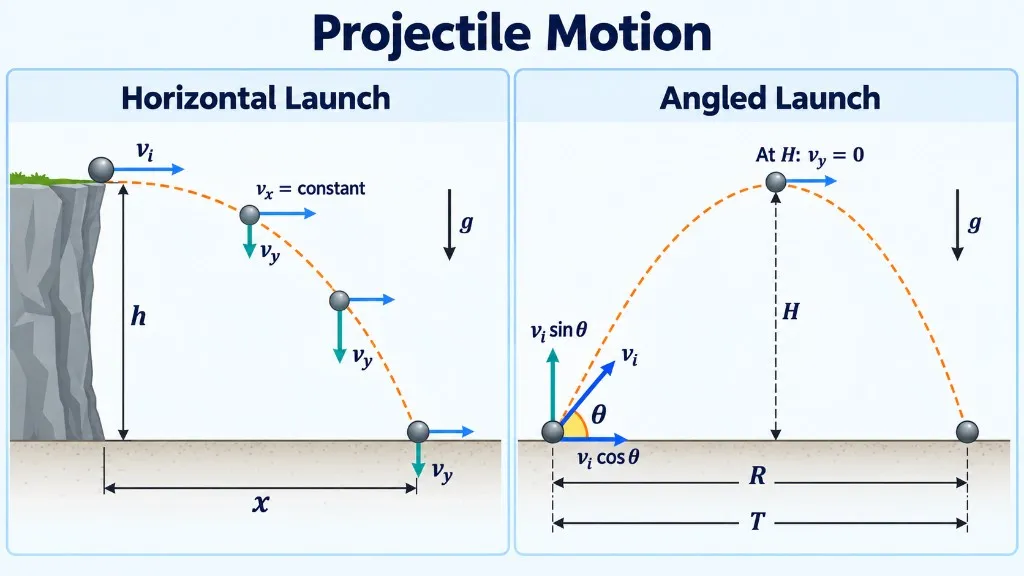
The formulas must also remain available as searchable HTML text and should not exist only inside the image.
33. Formula-Selection Table
Formula-Selection Table
| Required quantity | Formula |
|---|---|
| Horizontal component | v_i cos θ |
| Vertical component | v_i sin θ |
| Maximum height | vi² sin² θ2g |
| Time of summit | vi sin θg |
| Time of flight | 2 vi sin θg |
| Horizontal range | v_i² sin 2θ / g |
| Maximum range | vfraci²g |
| Horizontal-launch time | √(2h / g) |
34. Important Facts
- Projectile motion is two-dimensional.
- Horizontal and vertical motions are independent.
- Horizontal acceleration is zero without air resistance.
- Vertical acceleration is g downward.
- Horizontal velocity remains constant.
- Vertical velocity changes continuously.
- At maximum height, only the vertical velocity is zero.
- Maximum range occurs at 45° under ideal equal-level conditions.
- Complementary angles produce equal ranges for the same initial speed.
- Horizontal range formulas change if the launch and landing heights differ.
35. Key Logic
Always divide projectile motion into two independent parts: Horizontal Direction ax = 0 Use constant-velocity relations. Vertical Direction ay = −g Use uniformly accelerated motion equations. Both motions use the same value of time.
36. Tips and Tricks
- Resolve the initial velocity before starting.
- Keep horizontal and vertical calculations separate.
- Use the same time in both directions.
- At maximum height, set v_y = 0, not total v = 0.
- Use viy = 0 for a horizontal launch.
- Check whether landing and projection heights are equal.
- Use 45° for maximum range only under ideal equal-level conditions.
- Keep the calculator in degree mode.
- Write one mathematical step per line.
37. Common Mistakes
- Treating total velocity as zero at maximum height.
- Adding horizontal acceleration when air resistance is neglected.
- Using total initial velocity instead of its vertical component in the height formula.
- Applying equal-level range formulas to a projectile launched from a cliff.
- Using g = 0 at maximum height.
- Mixing upward-positive and downward-positive conventions.
- Using sin θ for the horizontal component.
- Forgetting the square on v_i in height and range formulas.
- Assuming air resistance keeps the trajectory parabolic.
- Confusing time of summit with total time of flight.
38. Remember Box
39. Exam Facts
- The ideal trajectory is parabolic.
- Range is maximum at 45°.
- Complementary angles produce equal ranges.
- Time of flight is twice the time of summit.
- The vertical component determines maximum height.
- The horizontal component determines horizontal motion.
- Gravity affects only the vertical component in the ideal model.
- The standard T and R formulas assume equal projection and landing heights.
40. Short-Question Preparation
Short-Question Preparation
Q. Why are horizontal and vertical projectile motions independent?
A. Gravity acts vertically downward and produces no horizontal acceleration in the ideal model. Therefore, horizontal velocity remains constant while vertical velocity changes. Both motions occur during the same time interval. They can be calculated separately and then combined to describe the complete motion.
Q. Is velocity zero at maximum height?
A. No. Only the vertical component of velocity is zero at maximum height. The projectile still possesses its horizontal velocity. Therefore, its total velocity is horizontal and non-zero. Its acceleration also remains equal to g downward.
Q. Why do complementary angles produce equal ranges?
A. The range depends upon sin 2θ. Complementary angles θ and 90° − θ produce equal sine values in the range equation. Therefore, projectiles launched with the same speed at complementary angles have equal ideal ranges.
44. Sticky Notes
Sticky Notes
- Projectile motion has horizontal and vertical components.
- ax = 0 in the ideal model.
- ay = −g when upward is positive.
- Horizontal velocity stays constant.
- At maximum height, vy = 0.
- Maximum range occurs at 45°.
- Complementary angles give equal ranges.
- Standard range formulas require equal launch and landing heights.
45. 60-Second Revision
vix = vi cos θ viy = vi sin θ H = vi² sin² θ2g T = 2 vi sin θg R = vi² sin 2θ / g Rmax = vfraci²g
46. Topic Summary
Projectile motion combines constant horizontal motion with uniformly accelerated vertical motion. Gravity changes only the vertical velocity in the ideal model. Resolving the initial velocity makes it possible to determine the projectile’s position, velocity, maximum height, time of flight and horizontal range.
Did you understand this topic?
Your answer is saved with your learning record. It does not mark the topic as mastered.
Exam preparation
Exam Focus
Quick revision
Revision Zone
Review the key facts, formulas and checks before you move on.Projectile Motion
Sticky Notes · Quick Revision
Components
- Projectile motion has horizontal and vertical components.
- ax = 0 in the ideal model.
- ay = −g when upward is positive.
- Horizontal velocity stays constant.
Same supplied content as this Notes page (shared canonical source).