









PhysicsChapter 4: Rotational and Circular Motion
Angular Momentum
Textbook Subtopics
- Angular momentum of a point mass
- Angular momentum of a rigid body
- Relationship between torque and angular momentum
- Conservation of angular momentum
- Applications: rotating person, gymnast/diver, gyroscope and flywheel
Overview
Angular momentum is the rotational form of linear momentum. It measures the quantity of rotational motion possessed by an object.
Linear momentum depends on mass and linear velocity:
p⃗ = m v⃗
Angular momentum depends on linear momentum and its perpendicular distance from the axis of rotation:
L⃗ = r⃗ × p⃗
Learning Outcomes
Students should be able to:
- Define angular momentum.
- Calculate its magnitude and direction.
- Derive L = Iω for a point mass and rigid body.
- Explain the relationship between torque and angular momentum.
- State the law of conservation of angular momentum.
- Solve numerical problems using L = Iω.
- Explain common applications of angular momentum.
1. Definition of Angular Momentum
Angular momentum L⃗ is defined as the cross product of position vector r⃗ and linear momentum p⃗:
L⃗ = r⃗ × p⃗
Where:
- L⃗ = angular momentum
- r⃗ = position vector from the rotation axis
- p⃗ = linear momentum
The magnitude is:
L = r p sin θ
Here, θ is the angle between r⃗ and p⃗.
2. Direction of Angular Momentum
Angular momentum is a vector quantity.
Its direction is determined by the right-hand rule:
- Point the fingers of your right hand along r⃗.
- Curl them towards p⃗.
- Your thumb gives the direction of L⃗.
For anticlockwise rotation, L⃗ points out of the plane.
For clockwise rotation, L⃗ points into the plane.
Angular Momentum
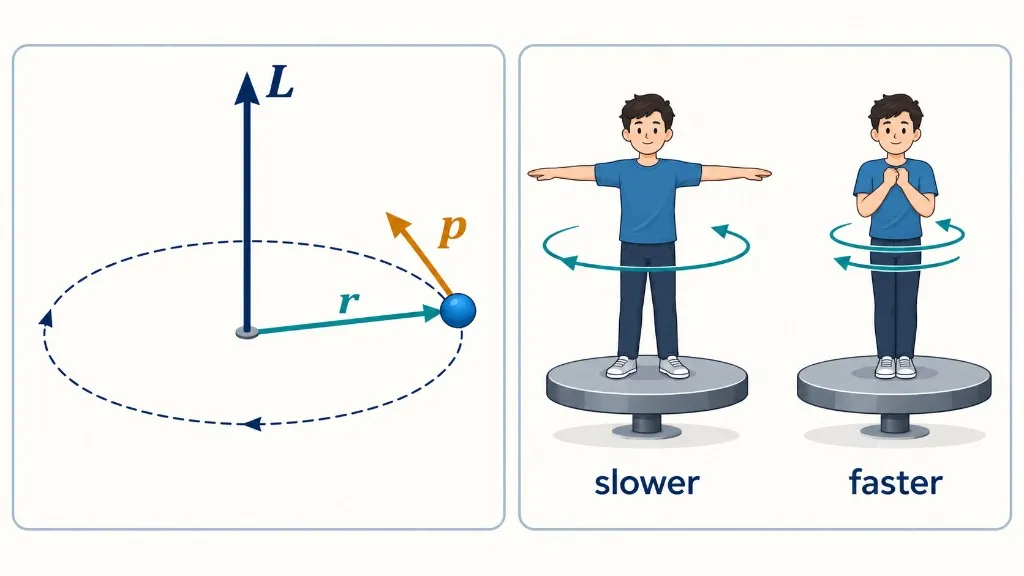
Searchable formulas: L⃗ = r⃗ × p⃗ · L = r p sin θ · L = Iω · Iᵢωᵢ = Iƒωƒ
3. SI Unit and Dimensions
From:
L = r p
Since:
[p] = kg m s⁻¹
Therefore:
[L] = m × kg m s⁻¹ [L] = kg m² s⁻¹
Its dimensional formula is:
[L] = [ML²T⁻¹]
Angular momentum may also be expressed as:
J s
because:
1 J s = 1 kg m² s⁻¹
Intermediate Level
4. Angular Momentum of a Point Mass
Consider a mass m moving in a circular path of radius r.
For circular motion:
θ = 90°
Therefore:
L = r p sin 90° L = r p
Linear momentum is:
p = m v
Therefore:
L = r (m v) L = m r v
The relationship between linear and angular velocity is:
v = r ω
Substituting:
L = m r (r ω) L = m r² ω
For a point mass:
I = m r²
Therefore:
L = I ω
This shows that angular momentum is the product of moment of inertia and angular velocity.
5. Angular Momentum of a Rigid Body
A rigid body consists of many small particles rotating about the same axis.
For the first particle:
L₁ = m₁ r₁² ω
For the second particle:
L₂ = m₂ r₂² ω
For the third particle:
L₃ = m₃ r₃² ω
Total angular momentum is:
Lnet = L₁ + L₂ + L₃ + ⋯ + Lₙ
Therefore:
Lnet = m₁ r₁² ω + m₂ r₂² ω + ⋯ + mₙ rₙ² ω
Taking ω as common:
Lnet = (m₁ r₁² + m₂ r₂² + ⋯ + mₙ rₙ²) ω
But:
I = Σ mᵢ rᵢ²
Hence:
Lnet = I ω
Why is ω common?
Every particle in a rigid body completes one rotation in the same time. Therefore, all particles have the same angular velocity even though their linear velocities may be different.
6. Relationship Between Torque and Angular Momentum
Angular momentum is:
L⃗ = r⃗ × p⃗
The rate of change of angular momentum is:
ΔL⃗ / Δt = r⃗ × (Δp⃗ / Δt)
According to Newton’s second law:
F⃗ = Δp⃗ / Δt
Therefore:
ΔL⃗ / Δt = r⃗ × F⃗
Torque is defined as:
τ⃗ = r⃗ × F⃗
Hence:
τ⃗ = ΔL⃗ / Δt
In instantaneous form:
τ⃗ = dL⃗ / dt
Meaning
- Torque changes angular momentum.
- Greater torque produces a faster change in angular momentum.
- If no external torque acts, angular momentum remains constant.
- The direction of torque is the same as the direction of change in angular momentum.
7. Conservation of Angular Momentum
Statement
When no external torque acts on a system, its total angular momentum remains constant.
Mathematically:
τ⃗external = 0
Since:
τ⃗ = ΔL⃗ / Δt
Therefore:
ΔL⃗ / Δt = 0
Hence:
ΔL⃗ = 0
Therefore:
L⃗f = L⃗i
Using L = Iω:
If ωf = Ii ωi
Where:
- I_i = initial moment of inertia
- I_f = final moment of inertia
- ω_i = initial angular velocity
- ω_f = final angular velocity
8. Relationship Between I and ω
When angular momentum remains constant:
I ω = constant
Therefore:
ω ∝ 1I
This means:
- If I decreases, ω increases.
- If I increases, ω decreases.
Mass distribution and angular velocity
| Mass distribution | Moment of inertia | Angular velocity |
|---|---|---|
| Mass farther from axis | Greater I | Smaller ω |
| Mass closer to axis | Smaller I | Greater ω |
Key Formula Summary
Key Formula Summary
| Concept | Formula |
|---|---|
| Vector definition | L⃗ = r⃗ × p⃗ |
| Magnitude | L = r p sin θ |
| Circular motion | L = r p |
| Point mass | L = m r² ω |
| Rigid body | L = I ω |
| Torque relationship | τ⃗ = ΔL⃗ / Δt |
| Conservation law | Li = Lf |
| Conservation using I | Ii ωi = If ωf |
Solved Examples
Example 1: Angular Momentum of a Point Mass
A 2 kg particle moves in a circle of radius 0.50 m with an angular velocity of 4 rad s⁻¹. Find its angular momentum.
Given:
m = 2 kg r = 0.50 m ω = 4 rad s⁻¹
Formula:
L = m r² ω
Solution:
L = 2(0.50)²(4) L = 2(0.25)(4) L = 2 kg m² s⁻¹
Final answer:
L = 2 kg m² s⁻¹
Example 2: Using Moment of Inertia
A wheel has a moment of inertia of 5 kg m² and rotates at 6 rad s⁻¹. Calculate its angular momentum.
Formula:
L = I ω
Solution:
L = (5)(6) L = 30 kg m² s⁻¹
Final answer:
L = 30 kg m² s⁻¹
Example 3: Conservation of Angular Momentum
A rotating system initially has:
Ii = 8 kg m² ωi = 3 rad s⁻¹
Its moment of inertia decreases to:
If = 2 kg m²
Find its final angular velocity.
Formula:
Ii ωi = If ωf
Solution:
(8)(3) = (2) ωf 24 = 2 ωf ωf = 242 ωf = 12 rad s⁻¹
Final answer:
ωf = 12 rad s⁻¹
The moment of inertia became one-fourth, so the angular velocity became four times greater.
Example 4: Textbook Grinding Wheel
A uniform cylindrical grinding wheel has:
M = 3.6 kg R = 31 cm = 0.31 m ωi = 1150 rpm = 120.4 rad s⁻¹
It stops in:
Δt = 7.8 s
Calculate its initial angular momentum and the torque required to stop it.
Part A: Angular momentum
For a solid disc:
I = (12) M R²
Angular momentum is:
L = I ω
Therefore:
L = (12) M R² ω L = (12)(3.6)(0.31)²(120.4) L = 20.83 kg m² s⁻¹
Part B: Stopping torque
τ = Lf − LiΔt τ = 0 − 20.837.8 τ = −2.67 N m
The negative sign shows that the torque acts opposite to the wheel’s rotation.
Applications
Rotating Person
When a rotating person extends their arms, mass moves farther from the axis.
I increases
Therefore:
ω decreases
When the arms are brought inward:
I decreases
Therefore:
ω increases
Angular momentum remains constant if external torque is negligible.
Gymnasts and Divers
During rotation, changing body position changes moment of inertia. A compact position produces a smaller moment of inertia and greater angular velocity. An extended position produces a greater moment of inertia and smaller angular velocity.
Gyroscope
A gyroscope contains a rapidly rotating wheel mounted so that its axis can change direction.
It uses angular momentum to:
- Maintain its orientation.
- Resist sudden changes in direction.
- Provide stability in navigation systems.
- Demonstrate the vector nature of angular momentum.
When external torque acts, the direction of angular momentum changes gradually. This motion is called precession.
Flywheel
A flywheel is a heavy rotating disc or wheel used to store rotational kinetic energy.
Its uses include:
- Smoothing power delivery in engines.
- Regulating the speed of machinery.
- Temporarily storing energy.
- Providing short-term backup power.
- Supporting some renewable-energy storage systems.
Important Exam Facts
- Angular momentum is a vector quantity.
- Its direction is found using the right-hand rule.
- Its SI unit is kg m² s⁻¹.
- Its dimensions are [ML²T⁻¹].
- For circular motion, r⃗ ⊥ p⃗.
- For a point mass, L = m r² ω.
- For a rigid body, L = I ω.
- Torque equals the rate of change of angular momentum.
- Only an external torque changes the total angular momentum of a system.
- When I decreases, ω increases if L remains constant.
Common Mistakes
- Treating angular momentum as a scalar.
- Writing L⃗ = p⃗ × r⃗, which reverses its direction.
- Forgetting the factor sin θ.
- Using L = r p when r⃗ and p⃗ are not perpendicular.
- Confusing angular momentum L with moment of inertia I.
- Using mass instead of moment of inertia in L = Iω.
- Forgetting to convert rpm into rad s⁻¹.
- Assuming angular momentum is conserved when external torque is present.
- Ignoring the negative sign of stopping torque.
MCQs with Answers
Short-Question Preparation
Short-Question Preparation
Q. Why is angular momentum a vector quantity?
A. Angular momentum is obtained from the cross product of position vector and linear momentum. A cross product has both magnitude and direction. Its direction is perpendicular to the plane containing r⃗ and p⃗.
Q. State the law of conservation of angular momentum.
A. If no external torque acts on a system, its total angular momentum remains constant. Therefore, initial angular momentum equals final angular momentum: Iᵢωᵢ = Iƒωƒ
Q. What is the relationship between torque and angular momentum?
A. Torque is the rate at which angular momentum changes: τ⃗ = ΔL⃗ / Δt. A larger torque produces a more rapid change in angular momentum.
Long-Question Preparation
A complete answer about angular momentum should contain:
- Definition of angular momentum.
- Vector equation L⃗ = r⃗ × p⃗.
- Magnitude L = r p sin θ.
- Direction using the right-hand rule.
- SI unit and dimensions.
- Circular-motion condition θ = 90°.
- Derivation of L = m r² ω.
- Use of I = m r².
- Final relationship L = Iω.
- Extension to a rigid body.
- Definition of torque.
- Derivation of τ = ΔLΔt.
- Statement of conservation of angular momentum.
- Condition of zero external torque.
- Formula Iᵢωᵢ = Iƒωƒ.
- Relationship between I and ω.
- Example of a rotating person.
- Applications of gyroscopes or flywheels.
Sticky Notes
Sticky Notes
- Core formula: L⃗ = r⃗ × p⃗
- Rigid-body formula: L = Iω
- Conservation condition: No external torque.
- Memory trick: Smaller I means larger ω, provided angular momentum remains constant.
- Direction warning: Use the right-hand rule; angular momentum does not point along the circular path.
60-Second Revision
L⃗ = r⃗ × p⃗ L = r p sin θ L = Iω τ⃗ = ΔL⃗ / Δt Iᵢωᵢ = Iƒωƒ Angular momentum is a vector. Its direction is perpendicular to the rotational plane. External torque changes angular momentum. Zero external torque means angular momentum is conserved. Decreasing moment of inertia increases angular velocity.
Did you understand this topic?
Your answer is saved with your learning record. It does not mark the topic as mastered.
Exam preparation
Exam Focus
Quick revision
Revision Zone
Review the key facts, formulas and checks before you move on.Angular Momentum
Sticky Notes · Quick Revision
Core ideas
- Core formula: L⃗ = r⃗ × p⃗
- Rigid-body formula: L = Iω
- Conservation condition: No external torque.
- Memory trick: Smaller I means larger ω, provided angular momentum remains constant.
Same supplied content as this Notes page (shared canonical source).