









PhysicsChapter 4: Rotational and Circular Motion
Torque and Angular Acceleration
Overview
Torque produces angular acceleration in rotational motion in the same way that force produces linear acceleration in translational motion.
Newton’s second law for linear motion is:
F = ma
Its rotational form is:
τ = Iα
Learning Outcomes
Students should be able to:
- Define torque and angular acceleration.
- Explain the connection between torque and angular acceleration.
- Derive τ = Iα for a point mass.
- Compare F = ma with τ = Iα.
- Calculate torque, moment of inertia or angular acceleration.
- Determine the direction and sign of angular acceleration.
1. Torque
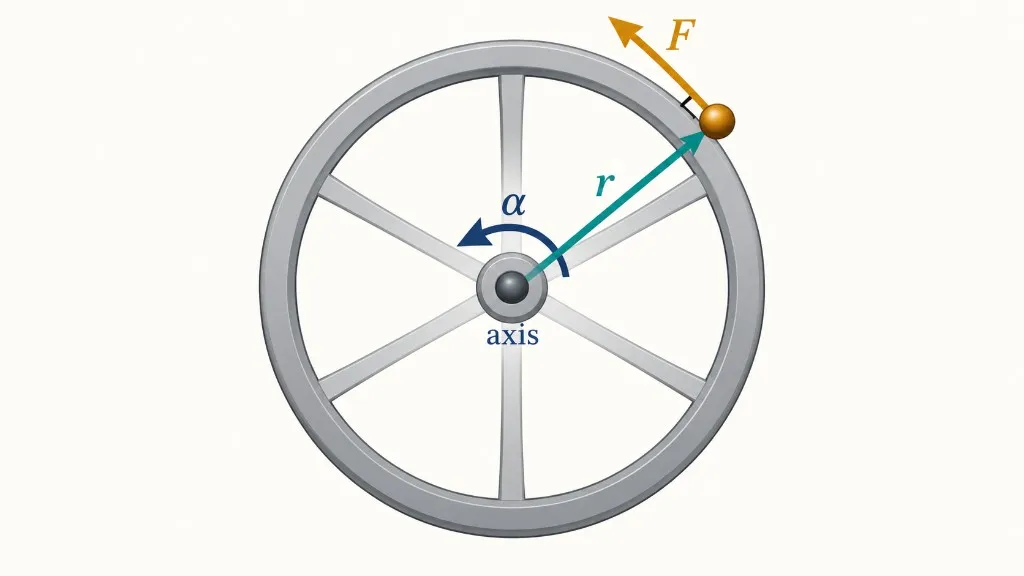
Torque is the turning effect produced by a force about an axis.
Its vector form is:
τ⃗ = r⃗ × F⃗
Its magnitude is:
τ = r F sin θ
Where:
- τ = torque
- r = perpendicular distance from the axis
- F = applied force
- θ = angle between r⃗ and F⃗
When the force is tangential:
θ = 90°
Therefore:
τ = r F sin 90° τ = r F
2. Angular Acceleration
Angular acceleration is the rate at which angular velocity changes.
α = Δω / Δt
Where:
- α = angular acceleration
- Δω = change in angular velocity
- Δt = time interval
Its SI unit is:
rad s⁻²
Its dimensions are:
[α] = [T⁻²]
3. Direction of Torque
Torque is a vector quantity. Its direction is found using the right-hand rule:
- Curl the fingers of your right hand in the direction in which the force tends to rotate the object.
- Your thumb gives the direction of torque.
- Angular acceleration acts in the direction of the net torque.
A common sign convention is:
- Anticlockwise torque: positive
- Clockwise torque: negative
The opposite convention may also be used, but it must remain consistent throughout the calculation.
Intermediate Level
4. Derivation of τ = Iα
Consider a point mass m rotating at a distance r from an axis. A tangential force F acts on it.
Torque is:
τ = r F sin θ
For tangential force:
θ = 90°
Therefore:
τ = r F
According to Newton’s second law:
F = m at
Tangential acceleration and angular acceleration are related by:
at = r α
Substituting:
F = m (r α) F = m r α
Now substitute this value of force into τ = r F:
τ = r (m r α) τ = m r² α
For a point mass:
I = m r²
Therefore:
τ = I α
This is the rotational form of Newton’s second law.
Torque and Angular Acceleration
Searchable formulas: τ = r F sin θ · τ = r F · τnet = Iα · α = τnet / I
5. Meaning of τ = Iα
From:
τ = I α
Angular acceleration is:
α = τI
Therefore:
α ∝ τ
For a constant moment of inertia, greater net torque produces greater angular acceleration.
Also:
α ∝ 1I
For the same torque, an object with greater moment of inertia has smaller angular acceleration.
6. Net Torque
When several torques act on an object, their signs and directions must be considered.
τnet = Σ τ
The complete rotational law is:
τnet = I α
For example, if anticlockwise is positive:
τnet = τanticlockwise − τclockwise
Only the net torque determines angular acceleration.
7. Linear and Rotational Motion Comparison
Linear and Rotational Motion Comparison
| Linear motion | Rotational motion |
|---|---|
| Displacement s | Angular displacement θ |
| Velocity v | Angular velocity ω |
| Acceleration a | Angular acceleration α |
| Mass m | Moment of inertia I |
| Force F | Torque τ |
| F = ma | τ = Iα |
Important Comparison
Mass represents resistance to linear acceleration.
Moment of inertia represents resistance to angular acceleration.
Force changes linear motion.
Torque changes rotational motion.
8. Special Conditions
Force passing through the axis
If the line of action of force passes through the axis:
r⊥ = 0
Therefore:
τ = 0
Such a force cannot produce angular acceleration about that axis.
Radial force
For a radial force:
θ = 0°
Therefore:
τ = r F sin 0° τ = 0
Tangential force
For a tangential force:
θ = 90°
Therefore:
τmax = r F
A tangential force produces the maximum torque for a given r and F.
Zero net torque
If:
τnet = 0
Then:
I α = 0
For a non-zero moment of inertia:
α = 0
The object either remains at rest or continues rotating with constant angular velocity.
9. SI Unit and Dimensions of Torque
From:
τ = I α
The unit of moment of inertia is:
kg m²
The unit of angular acceleration is:
rad s⁻²
Since the radian is dimensionless:
[τ] = kg m² s⁻²
Therefore:
SI unit of torque = N m
Dimensional formula:
[τ] = [ML²T⁻²]
Torque and energy have the same dimensions, but they are different physical quantities. Torque is measured in N m, while energy is written in joules.
Key Formula Summary
Key Formula Summary
| Quantity | Formula |
|---|---|
| Torque vector | τ⃗ = r⃗ × F⃗ |
| Torque magnitude | τ = r F sin θ |
| Tangential force | τ = r F |
| Angular acceleration | α = Δω / Δt |
| Tangential acceleration | at = r α |
| Moment of inertia of point mass | I = m r² |
| Rotational Newton’s second law | τnet = I α |
| Angular acceleration | α = τnet / I |
| Moment of inertia | I = τnet / α |
Solved Examples
Example 1: Angular Acceleration of a Wheel
A wheel has a moment of inertia of 2.5 kg m². A net torque of 10 N m acts on it. Calculate its angular acceleration.
Given:
I = 2.5 kg m² τ = 10 N m
Formula:
α = τI
Solution:
α = 102.5 α = 4 rad s⁻²
Final answer:
α = 4 rad s⁻²
Example 2: Torque Produced by a Tangential Force
A tangential force of 15 N acts at the rim of a wheel of radius 0.40 m. Calculate the torque.
Given:
F = 15 N r = 0.40 m θ = 90°
Formula:
τ = r F
Solution:
τ = (0.40)(15) τ = 6 N m
Final answer:
τ = 6 N m
Example 3: Required Torque
A rotating body has moment of inertia 0.80 kg m². Find the torque required to produce an angular acceleration of 12 rad s⁻².
Given:
I = 0.80 kg m² α = 12 rad s⁻²
Formula:
τ = I α
Solution:
τ = (0.80)(12) τ = 9.6 N m
Final answer:
τ = 9.6 N m
Example 4: Calculating Moment of Inertia
A torque of 18 N m produces an angular acceleration of 6 rad s⁻². Find the moment of inertia.
Formula:
I = τα
Solution:
I = 186 I = 3 kg m²
Final answer:
I = 3 kg m²
Example 5: Braking Torque
A wheel of moment of inertia 3 kg m² experiences a braking torque of −12 N m. Calculate its angular acceleration.
Formula:
α = τI
Solution:
α = −123 α = −4 rad s⁻²
Final answer:
α = −4 rad s⁻²
The negative sign indicates that the angular acceleration acts opposite to the original rotation.
Real-Life Applications
- A door rotates more easily when pushed far from its hinges.
- A mechanic applies torque using a wrench.
- Bicycle pedals produce torque around the crank axis.
- Electric motors produce torque to rotate machinery.
- Brakes apply torque opposite to the direction of rotation.
- A light wheel accelerates more easily than a heavy wheel when equal torques act.
Important Exam Facts
- Torque is the rotational effect of force.
- Angular acceleration is produced by net torque.
- The main formula is τnet = Iα.
- Moment of inertia plays the same role in rotation that mass plays in linear motion.
- A tangential force produces maximum torque.
- A radial force produces zero torque.
- Angular acceleration acts in the direction of net torque.
- A larger moment of inertia produces smaller angular acceleration for the same torque.
- Always calculate net torque before applying τ = Iα.
Common Mistakes
- Using force directly instead of calculating torque.
- Forgetting the factor sin θ.
- Using total distance instead of perpendicular distance.
- Using one torque when several torques act.
- Ignoring clockwise and anticlockwise signs.
- Confusing angular acceleration with centripetal acceleration.
- Writing the unit of torque as joules instead of N m.
- Applying τ = Iα using the wrong rotation axis.
MCQs with Answers
Short-Question Preparation
Short-Question Preparation
Q. Why is τ = Iα called the rotational form of Newton’s second law?
A. Newton’s second law states that force equals mass multiplied by linear acceleration. In rotational motion, torque replaces force, moment of inertia replaces mass, and angular acceleration replaces linear acceleration. Therefore, τ = Iα performs the same role for rotating objects.
Q. Why does a tangential force produce maximum torque?
A. A tangential force makes an angle of 90° with the radius. Since sin 90° = 1, the equation becomes τ = rF. Therefore, torque has its maximum value for the given force and radius.
Q. What happens when net torque is zero?
A. From τ_net = Iα, zero net torque gives zero angular acceleration. The object remains at rest or continues rotating with constant angular velocity.
Long-Question Preparation
A complete derivation should include:
- Definition of torque.
- Equation τ = r F sin θ.
- Tangential-force condition θ = 90°.
- Simplification to τ = r F.
- Newton’s second law F = m at.
- Relation at = r α.
- Substitution F = m r α.
- Substitution into the torque equation.
- Result τ = m r² α.
- Identification I = m r².
- Final result τ = Iα.
- Explanation of each symbol.
- SI units.
- Dimensional formula of torque.
- Comparison with F = ma.
- Effect of increasing torque.
- Effect of increasing moment of inertia.
- Direction of torque and angular acceleration.
Sticky Notes
Sticky Notes
- Core formula: τnet = Iα
- Memory comparison: Force changes linear motion; torque changes rotational motion.
- Maximum torque: Apply force perpendicular to the radius.
- Direction rule: Angular acceleration follows the direction of net torque.
- Exam warning: Use net torque, not merely one of the acting torques.
Ask-the-Tutor Modes
Students may select:
- Explain τ = Iα in simpler words.
- Show the derivation one step per line.
- Compare linear and rotational motion.
- Explain clockwise and anticlockwise signs.
- Check a numerical solution and its units.
60-Second Revision
τ = r F sin θ at = r α I = m r² τnet = Iα α = τ_net / I Torque produces angular acceleration. Tangential force produces maximum torque. Radial force produces zero torque. Greater torque means greater angular acceleration. Greater moment of inertia means smaller angular acceleration.
Did you understand this topic?
Your answer is saved with your learning record. It does not mark the topic as mastered.
Exam preparation
Exam Focus
Quick revision
Revision Zone
Review the key facts, formulas and checks before you move on.Torque and Angular Acceleration
Sticky Notes · Quick Revision
Core ideas
- Core formula: τnet = Iα
- Memory comparison: Force changes linear motion; torque changes rotational motion.
- Maximum torque: Apply force perpendicular to the radius.
- Direction rule: Angular acceleration follows the direction of net torque.
Same supplied content as this Notes page (shared canonical source).