









PhysicsChapter 4: Rotational and Circular Motion
Artificial Gravity
Overview
Artificial gravity is an apparent gravitational effect produced inside a spacecraft to reduce the difficulties caused by weightlessness.
It can be produced by rotating a ring-shaped space station. The station’s floor pushes occupants toward the centre, providing the centripetal force required for circular motion. Occupants experience this contact force as gravity-like weight.
Learning Outcomes
Students should be able to:
- Define artificial gravity.
- Explain how rotation produces a gravity-like effect.
- Identify the direction of centripetal force.
- Derive the required linear and angular velocity.
- Calculate time period and frequency.
- Explain how radius affects the required rotation rate.
- Solve numerical problems using artificial-gravity formulas.
1. Definition
Artificial gravity is the gravity-like effect produced artificially inside a spacecraft or satellite to reduce the effects of weightlessness.
A rotating space station can produce this effect.
The occupants stand on the inside surface of its outer rim. This surface acts as the floor.
2. How Is Artificial Gravity Produced?
Consider a ring-shaped space station rotating about its central axis.
An astronaut standing at its outer rim moves in a circular path. Therefore, an inward centripetal force is required.
The floor supplies this force as a normal reaction:
N = Fc
The astronaut experiences the normal reaction as apparent weight:
Wapparent = N
Therefore, the floor feels similar to the ground on Earth.
Artificial Gravity
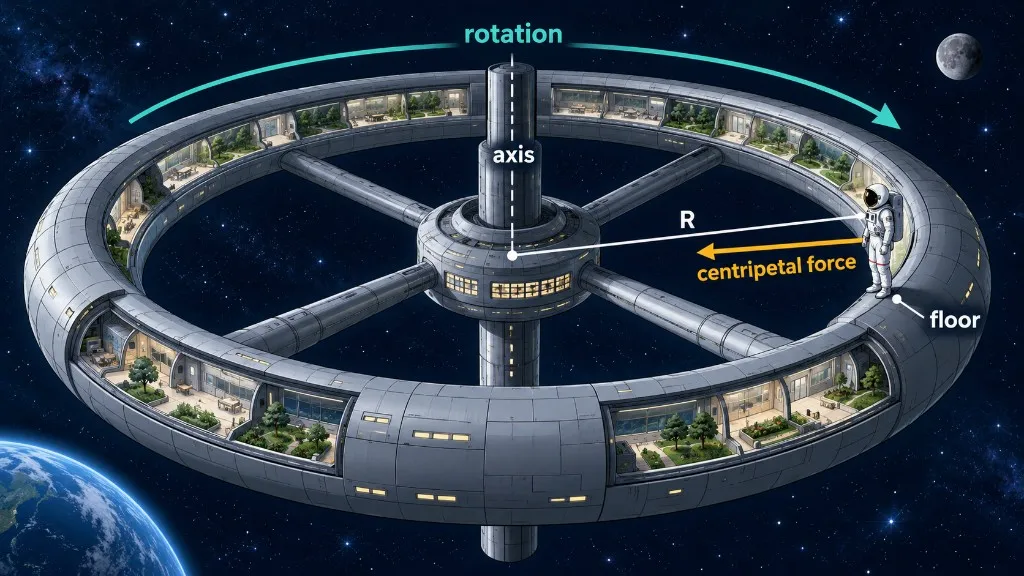
Important Directions
- Centripetal force acts inward, towards the axis.
- The astronaut presses against the outer rim.
- The outer rim acts as the floor.
- The astronaut experiences an apparent outward tendency in the rotating frame.
3. Effective Artificial Gravity
Centripetal acceleration is:
ac = v²R
It may also be written as:
ac = ω² R
For artificial gravity equal to Earth’s gravity:
ac = g
Therefore:
g = v²R
or:
g = ω² R
Where:
- R = radius of the rotating station
- v = linear speed at the rim
- ω = angular velocity
- g = required artificial gravitational acceleration
Intermediate Level
4. Required Linear Velocity
Centripetal acceleration is:
ac = v²R
To produce Earth-like artificial gravity:
ac = g
Therefore:
g = v²R
Multiplying both sides by R:
g R = v²
Taking the square root:
v = √(g R)
This is the required linear speed of the outer rim.
5. Required Angular Velocity
The relationship between linear and angular velocity is:
v = ω R
Also:
v = √(g R)
Therefore:
ω R = √(g R)
Dividing by R:
ω = √g RR
Writing R = √(R²):
ω = √(g RR²)
Therefore:
ω = √(gR)
Its SI unit is:
rad s⁻¹
6. Time Period of Rotation
The time period is the time required to complete one rotation.
Using circumference divided by linear speed:
T = 2π Rv
Since:
v = ω R
Therefore:
T = 2π Rω R
Cancelling R:
T = 2π / ω
Substituting:
ω = √(gR) T = 2π / √(gR)
Therefore:
T = 2π √(Rg)
Its SI unit is the second.
7. Frequency of Rotation
Frequency is the number of rotations completed per second.
f = 1T
Using:
T = 2π √(Rg)
Therefore:
f = 1 / (2π √(Rg))
Hence:
f = (1 / 2π) √(gR)
Its SI unit is:
hertz (Hz)
8. Effect of Radius
From:
ω = √(gR)
For constant artificial gravity:
ω ∝ 1 / √R
Therefore:
- A larger station requires a smaller angular velocity.
- A smaller station must rotate more rapidly.
- Increasing the radius allows a longer rotation period.
This is why large rotating stations are generally more suitable for producing a comfortable artificial-gravity effect.
9. Artificial Gravity at Different Distances
Artificial acceleration is:
ac = ω² R
For the same angular velocity:
a_c ∝ R
Therefore:
- At the rotation axis, R = 0, so artificial gravity is zero.
- Moving away from the axis increases artificial gravity.
- Artificial gravity is greatest at the outer rim.
The inner surface of the outer rim is therefore used as the floor.
10. Actual and Artificial Gravity
Actual and Artificial Gravity
| Actual gravity | Artificial gravity |
|---|---|
| Produced by gravitational attraction | Produced by rotation and contact force |
| Acts towards the centre of a massive body | Normal force acts towards the rotation axis |
| Exists without physical contact | Requires contact with the rotating floor |
| Approximately follows an inverse-square relationship | Follows ac = ω² R |
| Acts on all masses | The effect depends on position in the rotating station |
11. Rotation in Revolutions per Minute
If the rotation rate is given as n revolutions per minute:
f = n / 60
Angular velocity is:
ω = 2π f
Therefore:
ω = 2π n / 60
Artificial gravity can then be calculated from:
gartificial = ω² R
Complete Formula Table
Complete Formula Table
| Quantity | Formula |
|---|---|
| Centripetal acceleration | ac = v²R |
| Angular form | ac = ω² R |
| Required linear velocity | v = √(g R) |
| Required angular velocity | ω = √(gR) |
| Time period | T = 2π / ω |
| Earth-like gravity period | T = 2π √(Rg) |
| Frequency | f = 1T |
| Earth-like gravity frequency | f = (1 / 2π) √(gR) |
| rpm conversion | ω = 2π n / 60 |
Solved Examples
Example 1: Textbook Ring-Shaped Space Station
An astronaut stands on the rim of a rotating ring-shaped space station.
Given:
R = 1.50 km R = 1500 m g = 9.8 m s⁻²
Find:
- Angular velocity
- Time period
- Frequency
The astronaut’s mass does not affect these answers.
Part A: Angular Velocity
ω = √(gR) ω = √(9.81500) ω = √0.00653 ω = 0.0808 rad s⁻¹ ω ≈ 0.08 rad s⁻¹
Part B: Time Period
T = 2π √(Rg) T = 2π √(15009.8) T = 2π √153.06 T = 2π(12.37) T = 77.73 s T ≈ 77.73 s
Part C: Frequency
f = 1T f = 177.73 f = 0.0129 Hz f ≈ 0.013 Hz
Example 2: Artificial Gravity from Angular Velocity
A rotating station has radius 50 m and angular velocity 0.30 rad s⁻¹. Calculate the artificial gravitational acceleration at its rim.
Given:
R = 50 m ω = 0.30 rad s⁻¹
Formula:
ac = ω² R
Solution:
ac = (0.30)²(50) ac = (0.09)(50) ac = 4.5 m s⁻²
Final answer:
gartificial = 4.5 m s⁻²
Example 3: Finding Linear Speed
A rotating station has a radius of 100 m. Find the linear speed needed to produce an artificial acceleration of 9.8 m s⁻².
Formula:
v = √(g R)
Solution:
v = √((9.8)(100)) v = √980 v = 31.3 m s⁻¹
Final answer:
v ≈ 31.3 m s⁻¹
Applications
Artificial gravity may be useful for:
- Future rotating space stations.
- Long-duration space travel.
- Providing a clear floor direction inside spacecraft.
- Reducing some difficulties associated with prolonged weightlessness.
- Conducting experiments under controlled effective-gravity conditions.
Important Exam Facts
- Artificial gravity can be produced by rotating a spacecraft.
- The outer rim acts as the floor.
- The floor provides the inward centripetal force.
- Artificial acceleration is ac = ω² R.
- For Earth-like artificial gravity, ω = √(gR).
- A larger radius requires a smaller angular velocity.
- Artificial gravity is zero at the rotation axis.
- The occupant’s mass cancels from the equations.
- Frequency and time period are reciprocals.
Common Mistakes
- Drawing centripetal force away from the axis.
- Treating artificial gravity as actual gravitational attraction.
- Using diameter instead of radius.
- Forgetting to convert kilometres into metres.
- Forgetting to convert rpm into revolutions per second.
- Using ac = ω R instead of ac = ω² R.
- Confusing angular velocity with linear velocity.
- Including the astronaut’s mass when it cancels from the calculation.
- Using f = 2π / T instead of f = 1T.
MCQs with Answers
1. Artificial gravity in a ring-shaped station is produced by: A. Removing all gravitational forces B. Rotating the station C. Increasing the astronaut’s mass D. Stopping the station Answer: B — Rotation produces the required centripetal acceleration.
2. The station’s floor is located at: A. The rotation axis B. The outer rim C. The exact centre D. Outside the station Answer: B — The inside surface of the outer rim acts as the floor.
3. Artificial gravity at the rotation axis is: A. Maximum B. Equal to g C. Zero D. Infinite Answer: C — At the axis, R = 0, so a_c = ω² R = 0.
4. For constant artificial gravity, increasing the station’s radius: A. Increases the required angular velocity B. Decreases the required angular velocity C. Has no effect D. Makes angular velocity zero Answer: B — ω ∝ 1/√R.
5. The frequency of rotation is: A. f = T B. f = 2π T C. f = 1T D. f = T² Answer: C — Frequency is the reciprocal of the time period.
Short-Question Preparation
Short-Question Preparation
Q. What is artificial gravity?
A. Artificial gravity is a gravity-like effect created inside a spacecraft to reduce weightlessness. It can be produced by rotating a ring-shaped station. The rotating floor supplies the centripetal force needed to keep occupants moving in a circular path.
Q. Why does the outer rim act as the floor?
A. Centripetal acceleration increases with distance from the axis. At the outer rim, the station’s surface provides the inward normal force, and occupants experience this contact force as apparent weight.
Q. Why is a larger rotating station preferred?
A. For a required artificial gravity, ω = √(gR). Increasing radius decreases the necessary angular velocity. Therefore, a larger station can produce the same effect while rotating more slowly.
Long-Question Preparation
A complete answer should include:
- Definition of artificial gravity.
- Need for artificial gravity.
- Description of a rotating ring-shaped station.
- Identification of the outer rim as the floor.
- Direction of centripetal force.
- Equation ac = v²R.
- Condition ac = g.
- Derivation of v = √(g R).
- Relation v = ω R.
- Derivation of ω = √(gR).
- Definition of time period.
- Derivation of T = 2π / ω.
- Derivation of T = 2π √(Rg).
- Definition of frequency.
- Derivation of f = 1T.
- Final frequency formula.
- Effect of station radius.
- Difference between actual and artificial gravity.
Sticky Notes
Sticky Notes
- Main formula: g_artificial = ω² R
- Direction: Centripetal force always points toward the axis.
- Floor position: The inside of the outer rim acts as the floor.
- Radius rule: Larger radius means slower rotation for the same artificial gravity.
- Exam warning: Convert diameter into radius before using the formulas.
Ask-the-Tutor Modes
Students may select:
- Explain artificial gravity in simpler words.
- Show all four derivations one step per line.
- Explain why the outer rim acts as the floor.
- Convert rpm into angular velocity.
- Check a numerical solution and units.
60-Second Revision
ac = v²R = ω² R For Earth-like artificial gravity: v = √(g R) ω = √(gR) T = 2π √(Rg) f = (1 / 2π) √(gR) Rotation produces artificial gravity. The outer rim acts as the floor. The floor supplies centripetal force. A larger radius requires a smaller angular velocity. Artificial gravity is zero at the rotation axis.
Did you understand this topic?
Your answer is saved with your learning record. It does not mark the topic as mastered.
Exam preparation
Exam Focus
Quick revision
Revision Zone
Review the key facts, formulas and checks before you move on.Artificial Gravity
Sticky Notes · Quick Revision
Core ideas
- Main formula: g_artificial = ω² R
- Direction: Centripetal force always points toward the axis.
- Floor position: The inside of the outer rim acts as the floor.
- Radius rule: Larger radius means slower rotation for the same artificial gravity.
Same supplied content as this Notes page (shared canonical source).