









PhysicsChapter 4: Rotational and Circular Motion
Weightlessness in Satellites
Overview
Weightlessness is the condition in which an object’s apparent weight becomes zero or nearly zero.
Astronauts in an orbiting satellite appear to float, but this does not mean that Earth’s gravity has disappeared. The astronaut, satellite and everything inside it are continuously falling around Earth together.
Learning Outcomes
Students should be able to:
- Define weightlessness and apparent weight.
- Differentiate between mass, actual weight and apparent weight.
- Explain why astronauts float inside satellites.
- Explain orbital motion as continuous free fall.
- Show mathematically why apparent weight becomes zero.
- Correct the misconception that weightlessness means zero gravity.
- Describe some effects of prolonged microgravity.
1. Definition of Weightlessness
For example, while standing on the ground, the floor exerts an upward normal reaction on you. This supporting force creates the sensation of weight.
During free fall, this supporting force disappears.
2. Actual Weight
The gravitational force acting on an object is called its actual weight:
W = mg
Where:
- W = actual weight
- m = mass
- g = gravitational acceleration
Its SI unit is:
newton (N)
3. Apparent Weight
Apparent weight is the supporting or normal force acting on an object.
Wapparent = N
Where N is the normal reaction.
A weighing scale measures this normal force rather than directly measuring gravitational force.
Standing on a stationary surface
For vertical equilibrium:
N − mg = 0
Therefore:
N = mg
Thus:
Wapparent = W
During free fall
The object and its support fall with the same acceleration.
Therefore:
N = 0
Hence:
Wapparent = 0
This is the condition of weightlessness.
4. Mass, Weight and Apparent Weight
Mass, Weight and Apparent Weight
| Quantity | Meaning | Formula or unit | In an orbiting satellite |
|---|---|---|---|
| Mass | Amount of matter and measure of inertia | kilogram | Remains unchanged |
| Actual weight | Gravitational force | W = mg | Usually not zero |
| Apparent weight | Supporting or normal force | Wapparent = N | Becomes zero |
| Weightlessness | Zero apparent weight | N = 0 | Experienced during shared free fall |
Intermediate Level
5. Why Do Astronauts Float?
A satellite moves forward with a high tangential velocity while Earth’s gravity pulls it inward.
Instead of falling directly onto Earth:
- The satellite continually falls towards Earth.
- Earth’s curved surface continually moves away beneath it.
- The satellite therefore remains in orbit.
- The astronaut inside follows the same orbit.
- Nearby objects also fall with the same acceleration.
Because all of them fall together, the astronaut does not press against the spacecraft’s floor.
Therefore:
N = 0
Hence:
Wapparent = 0
The astronaut appears to float relative to the spacecraft.
Weightlessness in Satellites
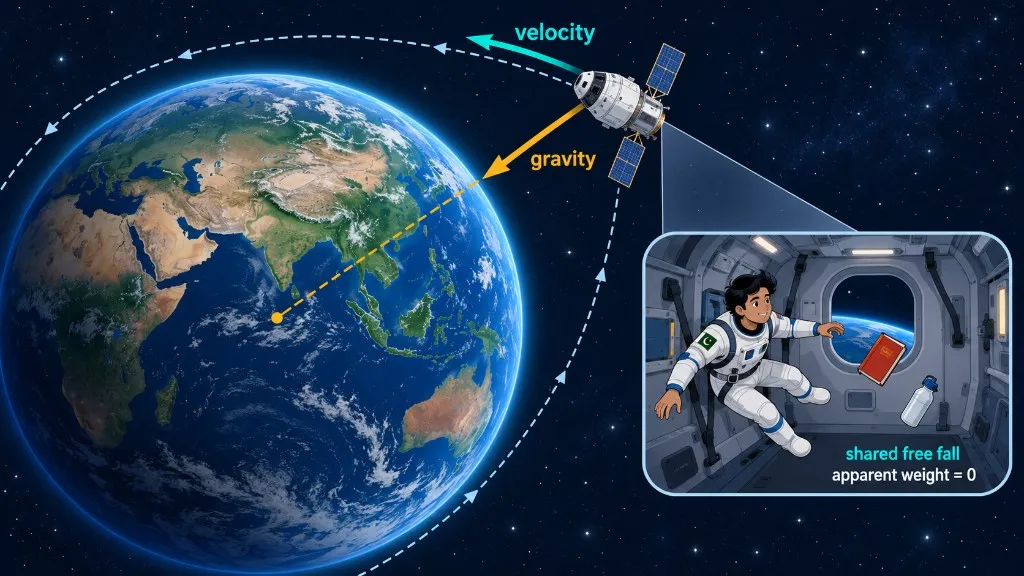
Searchable formulas: W = mg · Wapparent = N · N = m(g − a) · N = 0 in free fall · gorbit = v²r
6. Mathematical Explanation
Consider an astronaut of mass m inside an orbiting satellite.
The inward gravitational force is:
Fg = m gorbit
Suppose the floor exerts an outward normal force N. The net inward force is:
m gorbit − N = m ac
For a freely orbiting astronaut, gravity provides all the required centripetal acceleration:
ac = gorbit
Substituting:
m gorbit − N = m gorbit
Subtracting m g_orbit from both sides:
−N = 0
Therefore:
N = 0
Since apparent weight equals normal reaction:
Wapparent = N
Therefore:
Wapparent = 0
7. Weightlessness Is Not Zero Gravity
The expression “zero gravity” is often used informally, but it is not scientifically accurate for satellites in low Earth orbit.
Gravity is still strong enough to:
- Keep the satellite in orbit.
- Provide centripetal acceleration.
- Pull the astronaut towards Earth.
- Make the satellite and astronaut fall together.
If gravity were completely absent, the satellite would not follow its curved orbit. It would move in a straight line according to Newton’s first law.
8. General Expression for Apparent Weight
Suppose an object and its support accelerate downward with acceleration a.
Taking downward as positive:
mg − N = ma
Rearranging:
N = mg − ma N = m(g − a)
Since apparent weight is N:
Wapparent = m(g − a)
Stationary condition
If:
a = 0
Then:
N = m(g − 0) N = mg
Partial weightlessness
If:
0 < a < g
Then:
0 < N < mg
The person feels lighter but is not completely weightless.
Complete free fall
If:
a = g
Then:
N = m(g − g) N = 0
This is complete weightlessness.
9. Orbit as Continuous Free Fall
A satellite has two important motions:
- Forward motion due to its tangential velocity.
- Inward acceleration due to Earth’s gravity.
Gravity continually changes the direction of the satellite’s velocity. It therefore acts as the centripetal force:
Fg = Fc m gorbit = m v²r
Cancelling mass:
gorbit = v²r
Thus, the satellite and everything inside it have the same inward acceleration.
10. Do Objects Lose Their Mass?
No. Weightlessness does not mean that mass becomes zero.
An object in orbit still has:
- Mass
- Inertia
- Momentum
- Gravitational attraction
- Resistance to changes in motion
A massive object can therefore still be difficult to move or stop inside a spacecraft, even though it has zero apparent weight.
11. Microgravity
The environment inside an orbiting spacecraft is commonly described as microgravity.
It is called microgravity because perfect weightlessness may be disturbed by small effects such as:
- Air resistance on the spacecraft.
- Vibrations from equipment.
- Small differences in gravitational force across the spacecraft.
- Movement of people and machinery.
- Occasional engine operation.
Therefore, the apparent weight is extremely small but may not always be exactly zero.
Effects of Prolonged Microgravity
Long periods in microgravity can affect the human body because it no longer works continuously against ordinary Earth gravity.
Possible effects include:
- Weakening of muscles.
- Reduction in bone strength.
- Changes in the cardiovascular system.
- Changes in balance and orientation.
- Changes in how body fluids are distributed.
- Difficulties with ordinary activities such as eating and sleeping.
Astronauts follow specially designed exercise and health-monitoring programmes to reduce these effects.
Key Formula Summary
Key Formula Summary
| Concept | Formula |
|---|---|
| Actual weight | W = mg |
| Apparent weight | Wapparent = N |
| Downward acceleration | N = m(g − a) |
| Complete free fall | a = g |
| Weightlessness | N = 0 |
| Orbital condition | gorbit = ac |
| Centripetal acceleration | ac = v²r |
Solved Examples
Example 1: Apparent Weight on Earth
A student has a mass of 60 kg. Calculate the student’s apparent weight while standing on a stationary floor. Take g = 9.8 m s⁻².
Given:
m = 60 kg g = 9.8 m s⁻²
Formula:
N = mg
Solution:
N = (60)(9.8) N = 588 N
Final answer:
Wapparent = 588 N
Example 2: Apparent Weight During Free Fall
Calculate the apparent weight of the same 60 kg student during free fall.
Formula:
N = m(g − a)
During free fall:
a = g
Therefore:
N = m(g − g) N = m(0) N = 0
Final answer:
Wapparent = 0 N
The student’s mass remains 60 kg.
Example 3: Downward-Accelerating System
A 50 kg object and its support accelerate downward at 2 m s⁻². Find the apparent weight.
Given:
m = 50 kg g = 9.8 m s⁻² a = 2 m s⁻²
Formula:
N = m(g − a)
Solution:
N = 50(9.8 − 2) N = 50(7.8) N = 390 N
Final answer:
Wapparent = 390 N
The apparent weight is smaller than the actual weight because the system accelerates downward.
Example 4: Astronaut in Orbit
At a particular orbital height, suppose:
gorbit = 8.7 m s⁻²
The satellite and astronaut both have:
ac = 8.7 m s⁻²
Using:
m gorbit − N = m ac
Substituting:
m(8.7) − N = m(8.7)
Therefore:
N = 0
Final answer:
Wapparent = 0
Gravity is present, but the astronaut and satellite fall together.
Important Exam Facts
- Weightlessness means zero apparent weight.
- Apparent weight is equal to the normal reaction N.
- Mass does not become zero during weightlessness.
- Gravitational force is not necessarily zero.
- Satellites and astronauts are in continuous free fall.
- Gravity provides the centripetal force required for orbit.
- A weighing scale reads zero during complete free fall.
- Objects inside a spacecraft float because they share the same acceleration.
- “Microgravity” is more accurate than “zero gravity” for an orbiting spacecraft.
Common Mistakes
- Writing that gravity is completely absent in a satellite.
- Saying an astronaut’s mass becomes zero.
- Confusing actual weight with apparent weight.
- Thinking that a satellite is stationary above Earth.
- Forgetting that gravity supplies centripetal acceleration.
- Assuming floating objects have no inertia.
- Using W = 0 without specifying that it is the apparent weight.
MCQs with Answers
Short-Question Preparation
Short-Question Preparation
Q. What is weightlessness?
A. Weightlessness is the condition in which apparent weight becomes zero or nearly zero. It occurs when an object and its support fall together with the same acceleration. The gravitational force may still be present.
Q. Why is an astronaut weightless inside a satellite?
A. The satellite, astronaut and other objects inside it are all in continuous free fall around Earth. Since the astronaut does not press against a supporting surface, the normal reaction becomes zero.
Q. Does weightlessness mean zero gravity?
A. No. Gravity remains present and provides the centripetal force needed to keep the satellite in orbit. Weightlessness means zero apparent weight, not necessarily zero gravitational force.
Q. Does an astronaut lose mass in orbit?
A. No. Mass and inertia remain unchanged. Only the normal reaction and apparent weight become zero.
Long-Question Preparation
A complete answer should contain:
- Definition of weightlessness.
- Definition of apparent weight.
- Relationship Wapparent = N.
- Actual weight formula W = mg.
- Explanation of the normal reaction.
- Meaning of free fall.
- Derivation N = m(g − a).
- Free-fall condition a = g.
- Result N = 0.
- Explanation of orbital free fall.
- Tangential velocity of a satellite.
- Gravitational force acting inward.
- Gravity as centripetal force.
- Explanation of why astronauts float.
- Difference between mass and apparent weight.
- Correction of the zero-gravity misconception.
- Meaning of microgravity.
- Effects of prolonged microgravity.
Sticky Notes
Sticky Notes
- Main idea: Weightlessness means N = 0, not necessarily g = 0.
- Mass remains unchanged: An astronaut still has mass and inertia in orbit.
- Orbit: A satellite continually falls around Earth.
- Scale reading: A scale reads the normal reaction, so it reads zero during free fall.
- Exam warning: Write “zero apparent weight,” not simply “zero weight.”
Ask-the-Tutor Modes
Students may select:
- Explain orbital free fall in easy words.
- Compare mass, weight and apparent weight.
- Show why N = 0 one step per line.
- Explain why gravity remains present in orbit.
- Check a numerical calculation of apparent weight.
60-Second Revision
W = mg W_apparent = N N = m(g − a) During free fall: a = g Therefore: N = 0 Weightlessness means zero apparent weight. Mass does not disappear. Gravity remains present in orbit. Satellites and astronauts fall together. Gravity supplies the required centripetal acceleration.
Did you understand this topic?
Your answer is saved with your learning record. It does not mark the topic as mastered.
Exam preparation
Exam Focus
Quick revision
Revision Zone
Review the key facts, formulas and checks before you move on.Weightlessness in Satellites
Sticky Notes · Quick Revision
Core ideas
- Main idea: Weightlessness means N = 0, not necessarily g = 0.
- Mass remains unchanged: An astronaut still has mass and inertia in orbit.
- Orbit: A satellite continually falls around Earth.
- Scale reading: A scale reads the normal reaction, so it reads zero during free fall.
Same supplied content as this Notes page (shared canonical source).